
Rayls Bridges Traditional Finance and Decentralized Finance

 Prefer us on Google
Financial institutions and fintech companies around the world are diving into the blockchain market. The attempts to move existing financial assets and services such as stocks, bonds, funds, deposits, and payments on-chain are expanding beyond simple technological experiments. The advantages offered by blockchain, such as 24/7 trading, fast payments, programmability of assets, and efficient liquidity utilization, are triggering competition among financial companies for next-generation infrastructure.
However, it is still unclear which blockchain infrastructure will become the standard in the financial market. JP Morgan has built its own private blockchain infrastructure called Kinexys, while Robinhood has launched the Robinhood Chain based on Ethereum Layer 2. Stripe has developed its own Layer 1 focused on payments, and BlackRock is issuing BUIDL on various public blockchains such as Ethereum and Solana.
The reasons why institutions choose different methods such as private chains, their own Layer 1 and 2, or existing public blockchains are clear. Each financial institution has different requirements for privacy levels, regulatory requirements, processing performance, cost structures, and the need for connections to external liquidity.
In this context, Rayls, which aims to provide a blockchain for financial institutions, presents a slightly different approach. Instead of choosing between traditional finance and decentralized finance, it builds infrastructure that connects the assets and liquidity of public blockchains while maintaining the privacy and control required by financial institutions. Parfin, the developer of Rayls, has raised a total of $38 million in investments from Framework Ventures, ParaFi Capital, Tether, and others based on this vision and technological capability.
This article will explore the reasons why financial institutions find it difficult to directly utilize public blockchains, how Rayls connects private financial networks with public blockchains, and whether this model is leading to actual adoption by financial institutions.
1. The Wall Between Traditional Finance and Decentralized Finance
Public blockchains have opened up new possibilities that existing financial infrastructures could not provide. Assets can be programmed, trading can occur 24/7, and transactions and payments can be processed on a single ledger, reducing intermediary processes and costs. Thanks to the openness that allows anyone to access the same network, various assets and financial services can also be freely connected.
The problem is that this openness acts as a barrier to entry for financial institutions. For financial institutions to move assets on-chain, it is not enough for transactions to be fast and cheap. They must be able to control participants and assets in compliance with regulations while protecting customer information and trading strategies.
The most representative issue is privacy. Since the transaction history on public blockchains can be viewed by anyone, if the relationship between a specific address and a financial institution or customer is revealed, the balance, trading counterparties, and the flow of funds can be continuously tracked. While this transparency can enhance trust for individual investors, it poses a risk for financial institutions as customer assets, corporate cash flows, and investment positions are exposed to the outside.
Control is also necessary for regulatory compliance. Banks and securities firms must perform obligations such as customer verification (KYC), anti-money laundering (AML), and sanctions checks, and they must be able to freeze or recover specific assets if issues arise. However, it is difficult to apply these powers and responsibilities in the same way as the existing financial system on a public blockchain where anyone can participate freely.
For this reason, financial institutions have primarily utilized permissioned private blockchains. JP Morgan's Kinexys is a representative example. By limiting participants, they can protect customer information and transaction data while also securing control over network rules and assets.
However, private blockchains create another limitation. Networks built by institutions or consortiums remain closed ledgers that are not interconnected, making it easy for assets and liquidity to become isolated within each system. While tokenized assets can be freely issued and transferred within a specific financial institution, moving them to another institution or a public blockchain requires separate connection infrastructure. Thus, the problem of liquidity fragmentation in the existing financial market remains even after adopting blockchain.
Ultimately, the on-chain transition for financial institutions is not a matter of choosing between public and private blockchains. They must maintain privacy and control while being able to connect with the assets and liquidity of public blockchains when necessary.
In other words, how to connect the control of traditional finance with the openness of public blockchains within a single infrastructure is a key challenge that must be addressed for the full on-chain entry of financial institutions and companies.
2. Rayls: Infrastructure Connecting Private Financial Networks and Public Blockchains
2-1. Maintaining Internal Privacy of Institutions While Connecting to External Liquidity Through a Three-Tiered Structure
The core issue that Rayls aims to solve is enabling financial institutions to utilize the liquidity and interoperability of blockchains without disclosing customer information and transaction histories.
To achieve this, Rayls divides the network into three layers: Rayls Sovereign, Rayls Private Network, and Rayls Public Chain. The roles are clear. Sovereign handles internal operations of institutions, the Private Network connects institutions, and when necessary, the Public Chain extends to public blockchains and the DeFi market.
Rayls Structure. Source = Rayls
The innermost layer, Rayls Sovereign, is a private blockchain operated directly by financial institutions that is EVM-compatible. It operates independently within the institution's on-premises or private cloud, eliminating the need to disclose customer balances, transaction data, and keys to external networks.
Institutions can issue and transfer tokenized assets in this environment, and they can also implement functions necessary for regulatory compliance, such as asset freezing or seizure. A key feature is that instead of replacing existing core banking or KYC systems, they can connect through APIs. In other words, the existing financial infrastructure is maintained while some asset ledgers and transaction processing are transitioned to blockchain.
The next layer, Rayls Private Network, connects the Sovereigns of different financial institutions. Each institution maintains independent ledgers and data while being able to transfer assets or settle transactions with approved counterparts. Even if assets and payments are divided across different institutions' ledgers, they can be processed in a way that ensures simultaneous settlement (DvP) or no settlement at all. Functions necessary for regulation, such as participant management, asset approval and freezing, and transaction monitoring, can also be controlled within this network.
Importantly, this network does not necessarily need to be open to the outside. Institutions can transact only within the Private Network and can selectively connect to the Public Chain when necessary. Institutions can directly decide which assets and transactions to disclose and to what extent.
The outermost layer, Rayls Public Chain, serves to connect this institutional network to the public blockchain ecosystem. Assets permitted by institutions can move to other networks or access public liquidity through DeFi applications via this layer. Rayls supports token movement between layers through Teleport and has designed a separate messaging function to allow smart contracts from different networks to communicate.
Ultimately, the core of Rayls is not to move all financial activities to public blockchains. It is to keep sensitive data and core operations within the institution while selectively connecting only the necessary assets and transactions to the outside.
Through this, financial institutions can trade on-chain with other financial institutions while maintaining existing regulations and data control structures, and further utilize liquidity from users of public blockchains. Instead of choosing between privacy and openness, the approach of Rails is to connect the two environments.
2-2. A Technical Stack for Institutions that Achieves Fast Finality and Confidentiality
For financial institutions to move core operations on-chain, performance that can quickly finalize large transactions and confidentiality that does not expose transaction information to the outside is necessary. Rails implements this through the DAG-based consensus Axyl and the privacy protocol Enygma.
Axyl is a directed acyclic graph (DAG) based consensus where multiple validators process transactions simultaneously. The key is to separate the propagation of transaction data and the determination of transaction order by combining Narwhal and Bullshark. Narwhal allows multiple validators to share transactions in batches and organizes them in a DAG format to ensure data availability. Bullshark reads the created DAG to determine and finalize a single transaction order that all validators will execute identically. Subsequently, the Reth-based EVM execution layer processes transactions according to the finalized order.
This structure reduces bottlenecks that occur when transaction processing is concentrated on a single block producer and allows multiple validators to process data in parallel. It is also designed to maintain consensus safety even if less than one-third of the total voting power behaves maliciously or abnormally.
Axyl aims to process over 15,000 transactions per second while providing finality in less than one second. In initial consensus layer tests, a prototype consisting of four nodes recorded a throughput of about 250,000 TPS. This shows significant potential for further performance enhancement even as the network expands.
Transaction confidentiality is handled by Enygma. Enygma is designed not only to restrict network access but also to validate the validity of transactions while keeping transaction information hidden.
To achieve this, it combines zero-knowledge proofs and Pedersen Commitment. The actual balance of users and transaction amounts are hidden and recorded in the form of Pedersen Commitment. Through zero-knowledge proofs, it proves whether the sender has sufficient balance and verifies that the total amount of assets before and after the transaction matches using the mathematical properties of the commitment. This allows for confirmation that the transaction occurred normally without disclosing its contents.
Additionally, Enygma separates the Spending Key and Viewing Key. The Spending Key is used to transfer assets, while the Viewing Key is used to check transaction history. Financial institutions can provide only the Viewing Key to regulatory or auditing bodies when necessary to disclose transaction history. This allows for optional audits required by regulations while maintaining transaction confidentiality.
Progress is also being made in response to quantum computing. The key exchange that generates shared secrets among participants applies the NIST standard quantum-resistant algorithm ML-KEM. However, since the entire cryptographic stack, including zero-knowledge proofs, has not yet been transitioned to quantum resistance, it is accurate to view the current stage as one where only some core components are being transitioned.
Ultimately, Axyl plays the role of quickly processing and finalizing transactions, while Enygma validates their validity without disclosing transaction contents. Rails aims to implement the processing performance and transaction confidentiality required by institutions, along with the auditability needed by regulatory bodies, within a single EVM-based infrastructure.
2-3. Rails' Differentiated Design that Simultaneously Satisfies Decentralization and Compliance
If the multi-layer structure examined earlier connects the private financial networks of institutions with public blockchains, and Axyl and Enygma implement fast transaction finality and confidentiality, the next challenge is to operate this in a way that fits the actual financial market. Rails is designing predictability of costs and settlements, censorship resistance, and on-chain compliance together for this purpose.
First, to allow financial institutions to predict transaction costs and settlement times, standard token transfers and transaction fees have been fixed in dollar terms. This reduces cost fluctuations due to native token price changes while allowing for separate fees to be charged for transactions that require priority processing. Additionally, Axyl's deterministic finality quickly finalizes agreed transactions. This design aims to reduce settlement uncertainties that may arise in securities settlements or fund transfers between institutions.
Devices that limit transaction order manipulation are also included. Rails processes pending transactions in batches without exposing them to the public mempool, thereby suppressing certain malicious MEV such as front-running or sandwich attacks. Validators can prioritize batching transactions with higher fees, but subsequently, multiple validators process transaction data in parallel, and Bullshark determines the agreed order. This alleviates the concentration of transaction order determination authority on specific block producers.
A plan to complement the censorship resistance of public blockchains is also proposed. The Rails white paper suggests recording the state root commitment of the Public Chain on Ethereum and aims to establish a separate path for submitting transactions through Ethereum even if specific validators censor transactions. This concept seeks to utilize Ethereum as an additional verification and safety mechanism while maintaining the performance of the independent network. However, these features are still in the planning stage, and specific implementation timelines have not been disclosed.
The final aspect is on-chain compliance. Rails is designed to validate necessary regulatory requirements such as KYC, AML, CFT, and investor suitability on-chain using cryptographic proofs and LayeredID. In transactions between institutions, KYB certification is applied, while in transactions between institutions and individuals, identity qualifications required by dApps are applied, allowing for varying regulatory levels depending on the type of transaction.
Ultimately, Rails aims to build an environment that actual financial institutions can use by adding cost predictability, censorship resistance, and compliance to the private-public connection structure and Axyl-Enygma. The key is to maintain the control and regulatory compliance capabilities required by traditional finance while not giving up the openness and connectivity of public blockchains.
3. Expanding into Real Financial Infrastructure
Rails emphasizes its strength in providing the privacy and regulatory compliance that financial institutions require, along with a fast settlement environment, while also being able to expand into the assets and liquidity of public blockchains when necessary.
This structure has begun to be applied in some financial institutions and financial infrastructure companies. Notably, Brazil's financial market infrastructure company Núclea has utilized Rails for the tokenization of corporate receivables, and financial group XP has launched a dollar-linked digital asset USDXP for customers. Projects such as Brazil's central bank's Drex, JP Morgan's Project EPIC, and the Bank of England and the Bank for International Settlements Innovation Hub (BISIH) have verified privacy and interoperability technologies for institutions.
3-1. Applying Rails to Real Financial Services with Núclea and XP
The most concrete use case is Brazil's financial market infrastructure company Núclea. Núclea is a key financial infrastructure company in Brazil responsible for payment and financial asset registration and settlement, handling most of the bill-based payment registrations and about 90% of credit and debit card payment settlements in Brazil. As of 2024, it has processed over 40.7 billion transactions, with transaction amounts exceeding 18.4 trillion reais.
Nucleia is expanding the asset registration and settlement functions traditionally handled by existing financial infrastructure into the tokenization market. A prime example is the tokenization of Duplicata, a receivable that arises from transactions between companies. The goal is to digitize receivables using blockchain technology and connect them more efficiently to financial institutions and investors. According to the latest data released by Nucleia, the cumulative tokenization volume exceeded 300 million reais as of June 2025. Collaboration direction between Rails and Nucleia. Source: Rails
The foundational technology for this infrastructure is provided by Rails. Since June 2024, Nucleia has been using the Rails-based infrastructure in a production environment, and according to Rails, over 10,000 receivables have been tokenized and settled per week. This is significant as it goes beyond a simple technological experiment and processes assets that are actually handled in the existing financial market at a production scale.
In the future, the next step is to connect receivables issued in this private environment to a Public Chain, expanding on-chain liquidity with external investors. If assets issued in the existing financial market are connected to the public market, it will enable the realization of the private-public connection structure that Rails aims for.
XP is an example of Rails being applied beyond the financial market backend to customer-facing financial products. XP is a leading investment platform in Brazil that offers investment product brokerage, asset management, and institutional finance, and it is listed on NASDAQ. As of Q2 2026, customer assets are approximately 153.4 billion reais, with over 18,000 financial advisory personnel.
XP's brokerage firm Clear launched USDXP, which is collateralized 1:1 with the US dollar, based on the Rails infrastructure in March 2026. This is not a pilot for technology validation but a real service provided to Clear customers, with the issuance and trading of USDXP processed in the Rails private environment operated by XP. Users can secure dollar exposure 24/7 through the Clear platform. XP's achievements with Rails. Source: Rails
According to Rails, approximately 300 million dollars were issued in the first week of USDXP's launch. The next step is to connect USDXP issued in the private environment to the Public Chain, allowing for exchanges with other stablecoins like USDT and USDC in the external market and accessing global liquidity.
Additionally, the actual scope of institutional adoption and the asset on-chain pipeline are expanding. As of August 2026, Rails reported that its foundational infrastructure is installed and used in over 30 financial institutions. The Brazilian private credit tokenization platform AmFi aims to issue over 1 billion dollars in real financial assets on Rails by June 2027, and the Brazilian energy and logistics company NimoFast is also building infrastructure to on-chain energy and commodity-related assets based on Rails.
In the future, the key will be whether more institutions adopt and issue assets, and whether they can connect to the Public Chain to link with external investors and DeFi liquidity.
3-2. Drex, JP Morgan, and the Bank of England Validate Rails' Technological Potential in Institutional Environments
While Nucleia and XP are real-world applications of Rails, there are ongoing cases centered around central banks and global financial institutions that validate privacy, settlement, and interoperability technologies. Notable examples include Brazil's central bank's Drex, JP Morgan's Project EPIC, and the Bank of England's DLT Innovation Challenge in collaboration with the Bank for International Settlements Innovation Hub (BISIH).
The most representative case is Brazil's central bank's digital currency project, Drex. Drex is an experimental project that tests a structure for trading and settling central bank money, tokenized deposits, and financial assets on programmable infrastructure. In the pilot phase, the central bank directly tested Rails as one of the privacy solutions, validating the potential use of privacy technology in financial transactions such as central bank money transfers and delivery versus payment (DvP) for government bonds.
Verification with global financial institutions has also continued. Rails participated as one of the privacy technology providers in JP Morgan's Project EPIC, conducted by its blockchain division Kinexys in 2024. Project EPIC is a proof of concept (PoC) to validate the privacy, digital identity, and composability required in tokenized finance, and JP Morgan analyzed the potential use of various privacy solutions, including Rails, in its official report.
In 2025, Rails also participated in the DLT Innovation Challenge with the Bank of England and BISIH's London Center. This project examined whether wholesale central bank money could be safely settled on external programmable ledgers not directly operated by the central bank. Nine groups, including Rails, participated, and Rails presented approaches to interoperability between institutional financial infrastructures during the final showcase after four technical sessions.
However, it is difficult to interpret these cases as commercial adoption. Drex, Project EPIC, and the DLT Innovation Challenge are all projects that validate the potential and limitations of technology in institutional environments rather than actual operational system implementations. Nevertheless, it is clear that the privacy, regulatory compliance, and interoperability between institutions that Rails aims to solve align with the core challenges that central banks and global financial institutions seek to address.
4. Rails: An Infrastructure to Watch as Institutional Blockchain Adoption Accelerates
As the on-chain transition of financial assets expands, the requirements for blockchain from financial institutions are also changing. Beyond simply needing a fast and inexpensive network, infrastructure that can maintain the privacy and regulatory compliance of existing finance while connecting liquidity with other institutions and the public market is becoming increasingly important.
Rails' strength lies in its attempt to connect these two areas within a single structure. Through Sovereign and Private Network, institutions can maintain control over their data and assets, while Axyl and Enygma enable rapid transaction confirmation and confidentiality. By connecting to the Public Chain, Rails aims to extend financial assets that have remained within institutions to public blockchains.
So far, the foundation of this model has been confirmed through actual cases. Nucleia has processed receivables based on Rails, and XP has launched digital asset products for customers. Projects like Drex, JP Morgan, and the Bank of England have continuously validated the privacy and interoperability technologies required in institutional environments.
In this regard, Rails is an infrastructure that deserves attention at this point when the on-chain entry of financial institutions is becoming more pronounced. It provides a pathway for institutions to transition to blockchain while maintaining existing systems and regulatory frameworks, and in the long term, it can connect institutional assets to public liquidity. The fact that it has already secured experience in actual financial institution adoption and technology validation through global institutions also serves as a competitive advantage.
However, for the model proposed by Rails to be completed, companies need to adopt Rails as a practical commercial infrastructure, and the assets issued in private environments must actually expand to connect with external investors and DeFi liquidity through the Public Chain. It will be essential to observe how quickly the issuance and trading of institutional assets increase on the Public Chain and whether they connect with actual external liquidity.
If this process is successfully achieved, Rails has the potential to establish itself as a key infrastructure that connects traditional financial assets and users to public blockchains, going beyond a simple private blockchain for institutions.
This content is provided for general informational purposes only and doesn't constitute financial, investment, legal, or tax advice. Any events, rewards, online promotions, or related information mentioned herein should not be considered a recommendation, solicitation, or invitation to purchase, sell, trade, or otherwise deal in any crypto assets. Crypto assets are highly volatile and may result in loss. The availability of WEEX services, products, and related events may vary by region. You are responsible for ensuring that your participation is in accordance with applicable local laws and regulations.
You may also like

Why 22 Trillion-Dollar Giants Refuse to be 'Tokenized'?

Is 24/7 Trading a Necessity? Analyzing the Real Trading Rhythm of RWA Perpetual Contracts

Cyberattack on GMO in Japan: Trading Accounts Compromised, GMO Coin Claims to be Unaffected
Elon Musk's Grand Scheme to Undermine New Cloud Providers

Google Earnings on Oct 28: Will the Fed Decision Move GOOGL Stock?
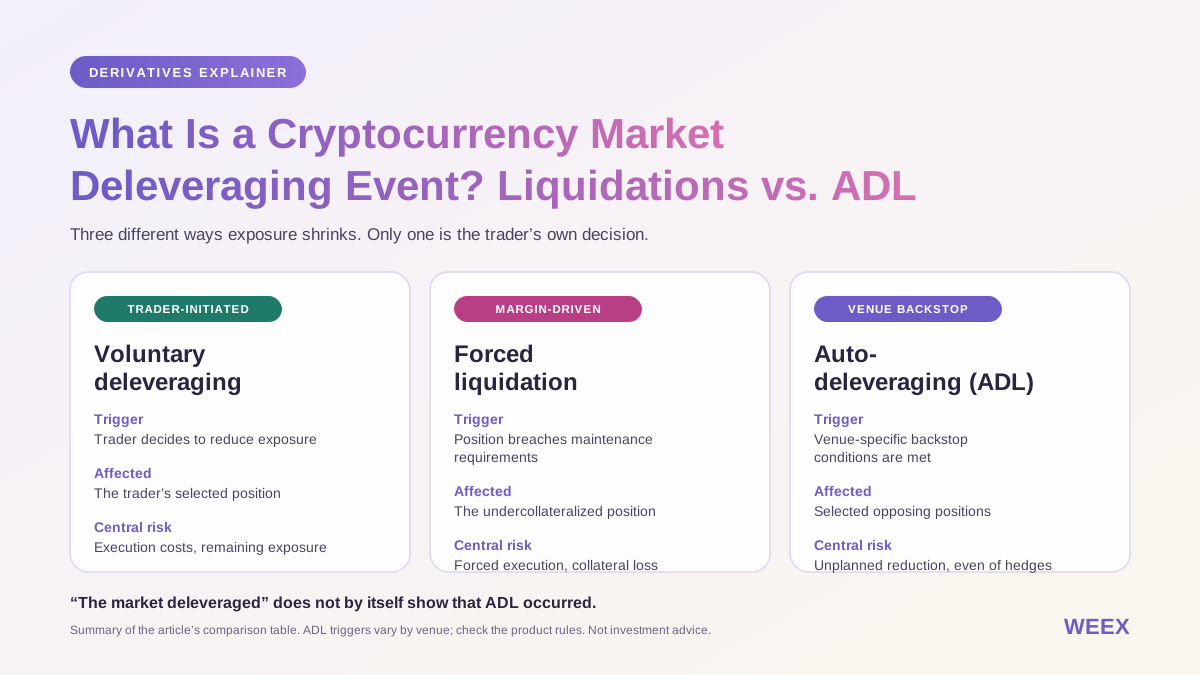
What Is a Cryptocurrency Market Deleveraging Event? Liquidations vs. ADL
Understand a cryptocurrency market deleveraging event: liquidation vs. ADL, misleading open-interest declines, hedge risks, and checks before trading.

The Week Ahead: 4 Key Moments for the Crypto Market
Do Prediction Markets Actually Bring Utility? – Tiger Research

Who Holds Tokenized Stocks? A Large Number of Retail Investors with Highly Concentrated Assets
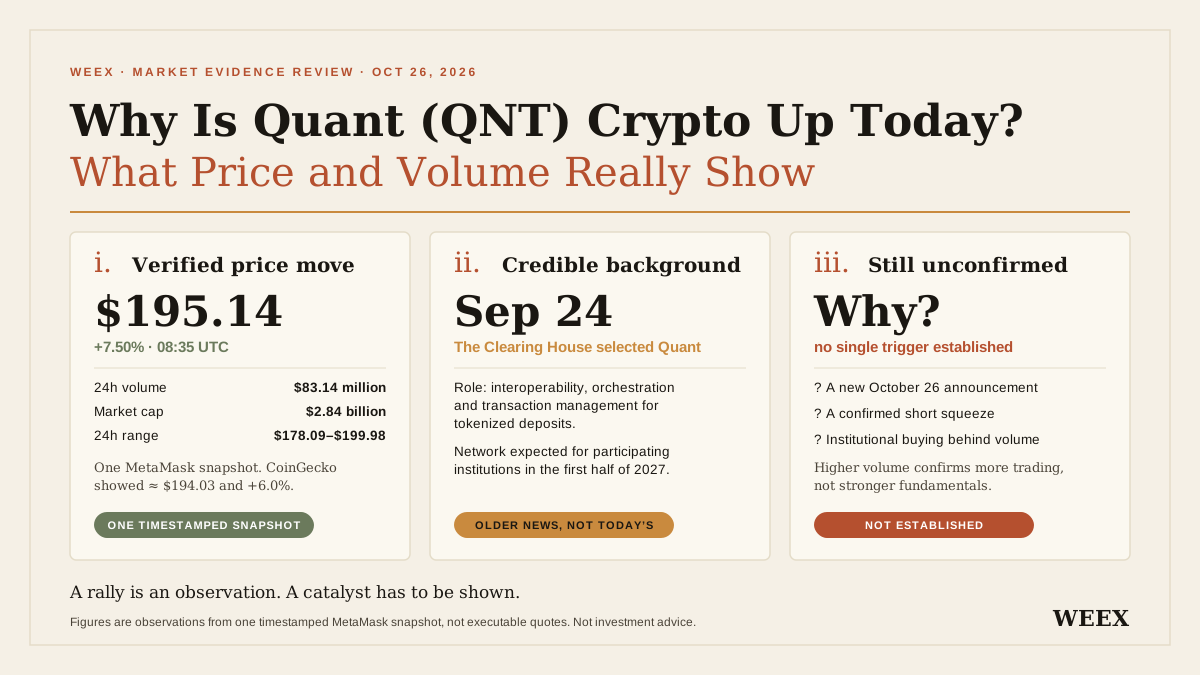
Why Is Quant (QNT) Crypto Up Today? What Price and Volume Really Show
Why is Quant (QNT) up today? Review price and volume evidence, the banking partnership timeline, token-demand assumptions, and risks before trading.
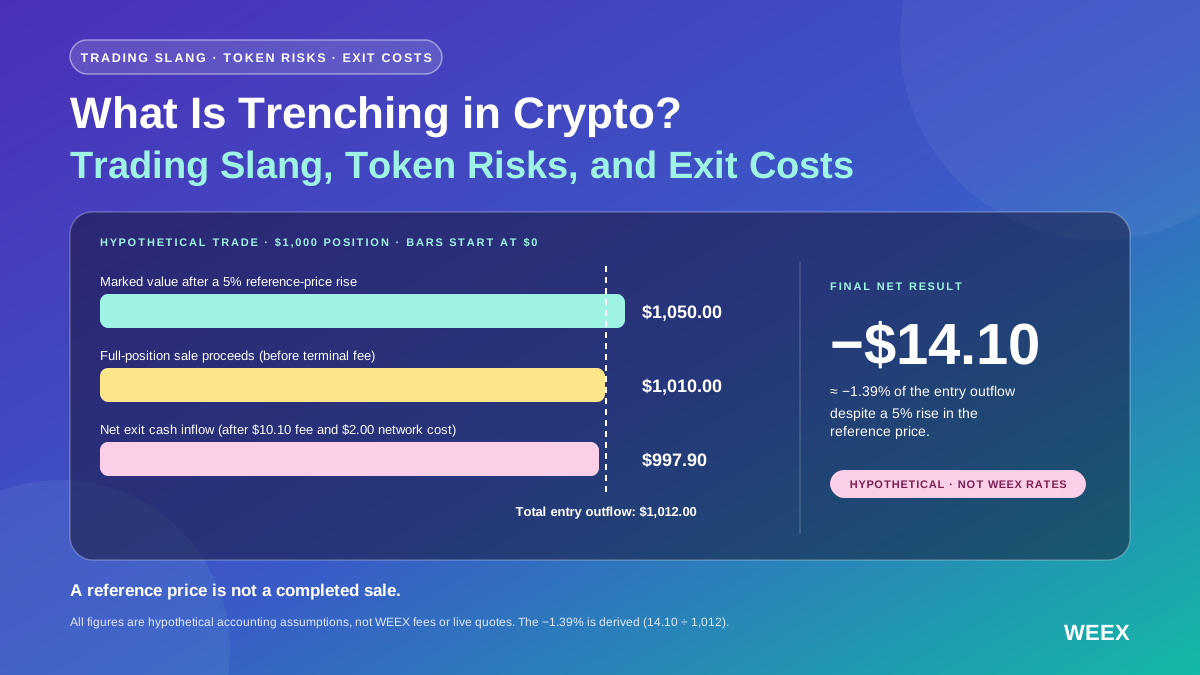
What Is Trenching in Crypto? Trading Slang, Token Risks, and Exit Costs
What is trenching in crypto? Learn the slang, token checks, liquidity risks, and how a rising token can still produce a loss after trading costs.

Flash Loans Secure Two Governance Seats: What Does the X100 Theft Teach the Industry?
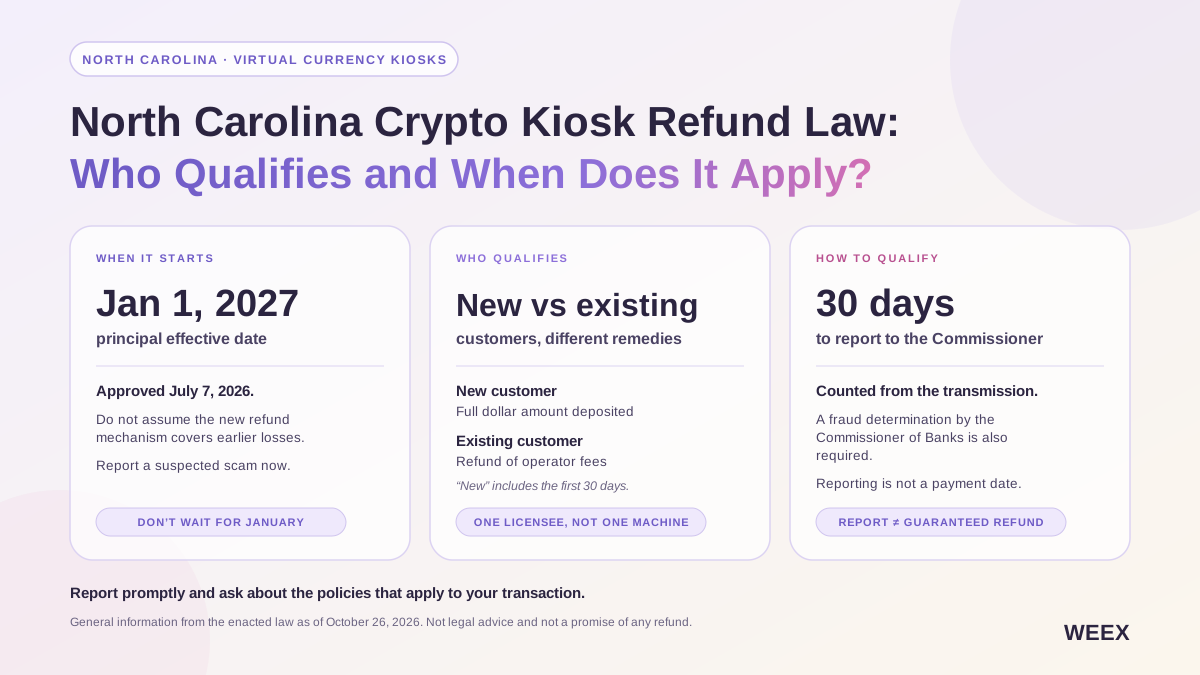
North Carolina Crypto Kiosk Refund Law: Who Qualifies and When Does It Apply?
Understand North Carolina’s crypto kiosk refund law: the January 2027 start date, who qualifies, reporting deadlines, and documents victims should keep.

AI Reduces Vulnerability Discovery Costs, Crypto Industry Divided in Response
Ethereum: Glamsterdam postponed after risks detected on 13 contracts

Who is Making Money from Digital Dollars? Profit Sharing Among Stablecoin Issuers, Distributors, and Payment Providers
Pump.fun: Why Displayed Gains Can Mislead Copy-Trading Enthusiasts

Diverging Sentiment in Altcoins: How Whales Operate Amid Market Panic

ECB says digital euro will give Europe control over its payment systems

IOSG: After KBW and TOKEN2049, with the crypto tide receding, who is still building?

Monero community backs 45 XMR proposal for core development

Risks Accumulate in the Global Economy: Double Threat from Trump, Debt Alarm in Artificial Intelligence

SEC's Crypto New Regulation Public Comment Period Ends: How Far Are We from 'Compliant ICO'?

HSBC Launches Hong Kong Dollar Stablecoin RedCoin on PayMe, Expanding to Over 3.3 Million Users and 100,000 Merchants

[Bitcoin $0 Controversy②] "$0 is an Exaggeration"... Reasons Wall Street Disagrees
Canada proposes direct stablecoin cash-outs for small holders with a 1% fee cap

[ETH Letter] Meritz Securities Reviews Tokenization of Korean Securities Based on OP Stack

Memecoin LIBRA: No charges for Javier Milei, Argentine justice sees no fraud

Fed Decision, GDP and PCE Set the Tone | WEEX Weekly Market Preview (10.26-10.30)

Gold Breaks Below $4,000, Bitcoin Pulls Back Below $80,000 | WEEX TradFi Daily(October 26, 2026)
At the October 23 close, major indexes were mixed, with the Dow weaker. Brent crude rose to about $116.7, a near six-month high, and energy led; gold briefly fell below $4,000 as Bitcoin pulled back toward $80,000. Cybersecurity stocks strengthened last week, with CrowdStrike up nearly 12%. Markets are watching whether Bitcoin’s correction is nearing its end, along with earnings from Verizon, Cadence, Celestica and Amkor today.
Why 22 Trillion-Dollar Giants Refuse to be 'Tokenized'?
Is 24/7 Trading a Necessity? Analyzing the Real Trading Rhythm of RWA Perpetual Contracts
Cyberattack on GMO in Japan: Trading Accounts Compromised, GMO Coin Claims to be Unaffected
Elon Musk's Grand Scheme to Undermine New Cloud Providers
Google Earnings on Oct 28: Will the Fed Decision Move GOOGL Stock?
What Is a Cryptocurrency Market Deleveraging Event? Liquidations vs. ADL
Understand a cryptocurrency market deleveraging event: liquidation vs. ADL, misleading open-interest declines, hedge risks, and checks before trading.


