
Flash Loans Secure Two Governance Seats: What Does the X100 Theft Teach the Industry?

 Prefer us on Google


Original | Odaily Planet Daily (@OdailyChina)
Author | Asher (@Asher_0210)
On October 24, the Ethereum DeFi project X100 suffered a governance attack, resulting in the theft of approximately 4.85 million USDT. According to GMGN data, the market cap of the X token plummeted from about $760 million before the attack to around $24 million, with a single-day decline of over 96%.
The treasury, originally managed by three "Senate" seats, was compromised by hackers using funds borrowed through flash loans to seize two of the seats. With the majority vote in hand, the hackers submitted a malicious proposal and voted it through with their controlled seats, allowing the treasury to approve a transaction that transferred assets to themselves. After the initial attack was successful, other attackers continued to exploit the same governance mechanism to siphon off project assets.
Below, Odaily Planet Daily will outline the entire process of this governance attack and the security vulnerabilities in DAO governance exposed by the X100 incident.
How Did Hackers Seize Two "Senate" Seats with $1.94 Million?
The treasury of X100 is managed by a three-seat Senate called Senate, where members vote on operations such as the sale of treasury tokens and liquidity deployment. Controlling just two seats allows one to propose and mobilize treasury assets. Holders deposit the project token X into a Freezer contract, choosing to freeze for one, three, or five years, and pay a registration fee of 100 X to participate in the election. The three seats are ranked in real-time according to the current frozen balance of the participating addresses, with the top three gaining governance rights.
This mechanism does not restrict the same controller from obtaining seats through multiple addresses, nor does it set a waiting period for governance rights to take effect. Attackers only need to ensure that the frozen balances of two controlled addresses simultaneously enter the top three to immediately gain the majority vote; proposals passed can also be executed immediately, allowing the seizure of seats and asset transfers to occur in the same transaction.
Before the attack, the second seat address had frozen about 19,000 X. At 22:11 on October 24, the hackers borrowed approximately 1.94 million USDT through an Aave flash loan, purchased X, and allocated it to two auxiliary contracts, completing the freezing and election. Each contract froze 19,000.000001 X, just one-millionth more than the original second seat, simultaneously occupying the second and third seats, pushing the original second seat out of the governance list.
After obtaining the majority vote, how did the hackers transfer treasury assets into their hands?
Two Votes Approved the Treasury to Sell 400,000 X at $35.68
After securing two seats, the hackers immediately submitted a malicious proposal requesting the treasury to sell 400,000 X into a PancakeSwap V3 X/USDT pool they created, setting the minimum received amount to zero, and then voted in support through another controlled contract, allowing the proposal to pass with two votes and be executed immediately. According to GoPlus analysis, X100 allows governance proposals to specify trading pools but lacks effective minimum transaction amount protection. The hackers could decide where the treasury sold the tokens and set their own transaction conditions, then approve the transaction with their controlled majority vote.
The aforementioned pool was created by the hackers in the same transaction, injecting only about $100 of liquidity. When the treasury sold 400,000 X into it, the pool could only pay a small amount of USDT, and since the minimum received amount was zero, the transaction did not fail due to low returns. Ultimately, the treasury handed over 400,000 X, receiving only about $35.68 in return. The hackers then withdrew the liquidity from their created pool, reclaiming the X, and sold part of the tokens into an existing Uniswap V3 X/USDT trading pool for USDT. After repaying the flash loan and other expenses, the first hacker made a profit of about 4.75 million USDT.
From borrowing to purchase tokens, seizing seats, approving the treasury to sell tokens at a low price, and cashing out to repay, all were completed in the same transaction. The tokens handed over by the treasury became the hackers' cash-out chips, while the USDT in the real trading pool was used to repay the loan and converted into attack profits.
Subsequent Attacks Followed: Where Did the Stolen Funds Go?
About 24 minutes after the first attack, a second hacker used a flash loan to seize two governance seats again, removed part of the Uniswap V3 liquidity positions held by Freezer, and continued to transfer assets using their created trading pool, obtaining about 96,400 USDT. About five minutes later, a third wallet utilized the auxiliary contract left by the second hacker, which had no restrictions on callers, directly borrowed their governance seat to propose and transfer about 550,000 X. The first two rounds of attacks caused a loss of about 4.85 million USDT, and the third round saw an additional approximately 550,000 X transferred, all occurring within less than half an hour.
According to Bitquery tracking, the first hacker exchanged the main USDT profits for ETH within minutes after the attack, then dispersed it across five wallets, totaling about 2,022.86 ETH. The second hacker exchanged USDT for ETH, routing through an intermediary address to ChangeNOW, with the entire transfer process taking about 21 minutes.
Once governance rights are lost, asset transfers quickly evolve from a single attack by the first hacker to multiple wallets participating in the siphoning. Later participants did not even need to repurchase tokens to run for election; they could continue to transfer assets using existing permissions.
-- Price
The Cost of Governance Attacks is Decreasing in the On-Chain World
X100 is not an isolated case; governance attacks do not necessarily require hackers to invest large sums of money in advance. Attackers can either purchase tokens to gain voting rights or look for opportunities with lower proposal thresholds, while flash loans allow borrowed funds to participate in governance power grabs.
Since the beginning of this year, similar governance attacks have caused significant losses multiple times. In July, Bonk DAO attackers spent about $4.09 million to purchase tokens representing 1.003% of the supply, just exceeding the governance approval threshold, and then transferred about $20.5 million in assets through malicious proposals, reclaiming their staked tokens after the voting ended. In August, Term Finance suffered a loss of about $8.5 million due to a governance attack. Even if millions of dollars are needed to purchase voting rights, this amount may not be the final cost borne by the attackers.
Some thwarted attacks had thresholds of only a few hundred dollars. In March this year, Moonwell attackers spent only about $1,808 to purchase MFAM and self-delegate, submitting a malicious proposal to attempt to gain control over seven lending markets and core contracts involving about $1.08 million in user funds. In September, Olas attackers spent only about $135 to lock 5,100 OLAS, exceeding the proposal threshold. Although both attacks were intercepted, they indicate that attackers do not necessarily need to hold the majority vote; merely obtaining proposal eligibility can create opportunities for attacks.
On October 22, Arkadiko also suffered a governance attack. The attackers purchased enough DIKO to vote alone to pass a proposal introducing a malicious contract, with no opposing votes during the process, resulting in an estimated loss of about $1.09 million.
Governance rights can be borrowed, and voting approval can transfer assets. When control of the treasury is so easily transferred, who can the so-called decentralized governance protect?
This content is provided for general informational purposes only and doesn't constitute financial, investment, legal, or tax advice. Any events, rewards, online promotions, or related information mentioned herein should not be considered a recommendation, solicitation, or invitation to purchase, sell, trade, or otherwise deal in any crypto assets. Crypto assets are highly volatile and may result in loss. The availability of WEEX services, products, and related events may vary by region. You are responsible for ensuring that your participation is in accordance with applicable local laws and regulations.
You may also like
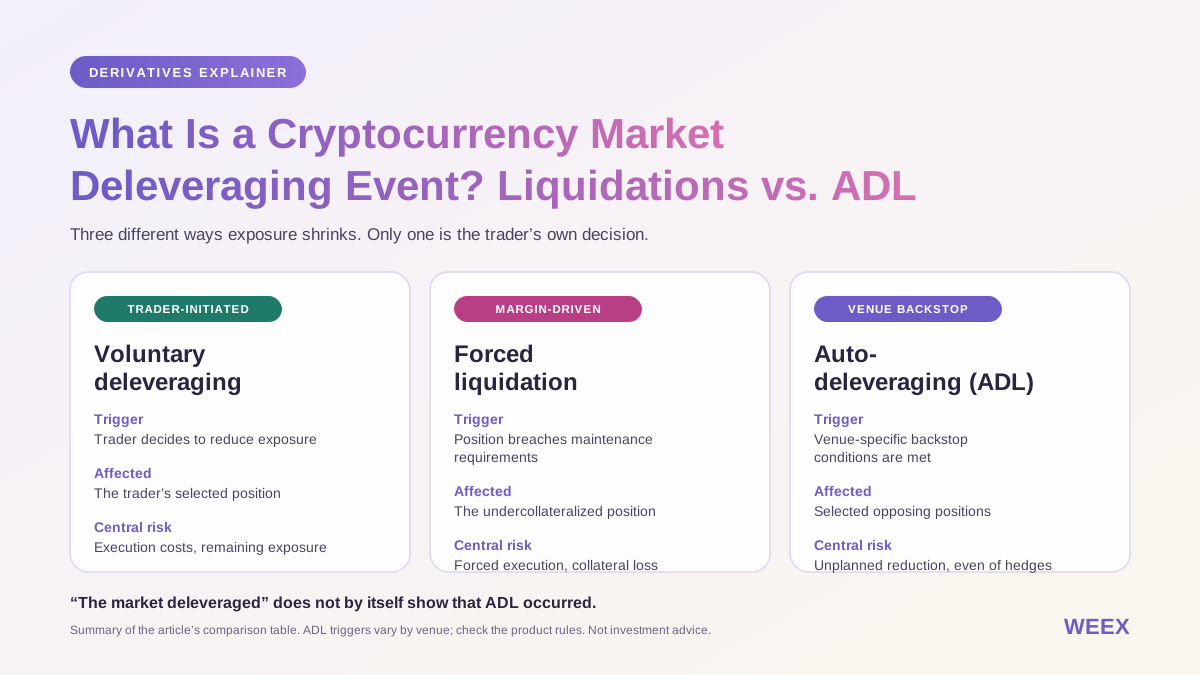
What Is a Cryptocurrency Market Deleveraging Event? Liquidations vs. ADL
Understand a cryptocurrency market deleveraging event: liquidation vs. ADL, misleading open-interest declines, hedge risks, and checks before trading.

Who Holds Tokenized Stocks? A Large Number of Retail Investors with Highly Concentrated Assets

AI Reduces Vulnerability Discovery Costs, Crypto Industry Divided in Response

Real and Fake Cryptocurrency Market Makers: What Makes a Market Maker Legitimate?

Evernorth takes a page from Michael Saylor’s Bitcoin playbook with new $80 million XRP funding plan

UK Prepares to Address Major Incidents Involving AI Agents: What Incident Plans Do Businesses Need?

Dragonfly Partner Responds to DFINITY's Technology Infringement Allegations, Related Patent Approved at the End of July

Who actually decides if a major crypto update goes ahead?

XRP: The number of wallets reaches a record 8.24 million

Chain Theory Proposes Deriving the Fine Structure Constant Using Quantum Information

Aave lowers USDT borrowing rate kink to 92% on Ethereum market

Circle Shareholders and Sun Yuchen File Lawsuits Amid Ongoing Controversy Over Trump's Family Crypto Business WLFI

Analysis of the NEAR and ICP Dfinity Public Chain Dispute

New OCC stablecoin rule resets redemptions, and banks face big shifts

Tether’s own AI study shows when buying a laptop costs more than cloud tokens

The Rise of Perp DEXs: Will On-Chain Options Change the Landscape?

Virtuals Butler Launches Automated Options Trading on Derive
The Past of Prince Group: $15 Billion in Bitcoin Frozen on the Chain

Tether Releases Voice Recognition Model for Local Use on Mobile and PC
Waller Faces a Tough Battle Next Week: Pausing Rate Hikes is Easy, But How to Stabilize Inflation Expectations?

HTX Research's Latest Report Interprets Midterm Elections and the Crypto Market: Elections Change Policy Expectations, Macro and Capital Determine Market Limits

Anthropic Set to IPO, Crypto Market Prices in $1.9 Trillion Valuation?
RedStone Launches New FIL Price Feed on Filecoin for Apps

Total Inflows in XRP ETFs Reach $1.8 Billion

A Midnight privacy-vault demo needs outside signers to release Ethereum tokens

How Should Heirs Legally Withdraw Cryptocurrency Left by Deceased Relatives?
Ripple teams up with $10B payments firm Arf to expand RLUSD use on XRPL

DFINITY Founder Accuses NEAR Intents of Misappropriating Proprietary Technology

U.S. Blockchain Association Calls for Advancement of Digital Asset Tax Legislation

Are Meme Stock Tokens a Passing Fad or a New Gateway to Traditional Securities Markets?
What Is a Cryptocurrency Market Deleveraging Event? Liquidations vs. ADL
Understand a cryptocurrency market deleveraging event: liquidation vs. ADL, misleading open-interest declines, hedge risks, and checks before trading.
Who Holds Tokenized Stocks? A Large Number of Retail Investors with Highly Concentrated Assets
AI Reduces Vulnerability Discovery Costs, Crypto Industry Divided in Response
Real and Fake Cryptocurrency Market Makers: What Makes a Market Maker Legitimate?
Evernorth takes a page from Michael Saylor’s Bitcoin playbook with new $80 million XRP funding plan
UK Prepares to Address Major Incidents Involving AI Agents: What Incident Plans Do Businesses Need?
Contents
Latest articles


Latest coin listings on WEEX


