
North Carolina Crypto Kiosk Refund Law: Who Qualifies and When Does It Apply?

 Prefer us on Google


North Carolina Crypto Kiosk Refund Law: Who Qualifies and When Does It Apply?
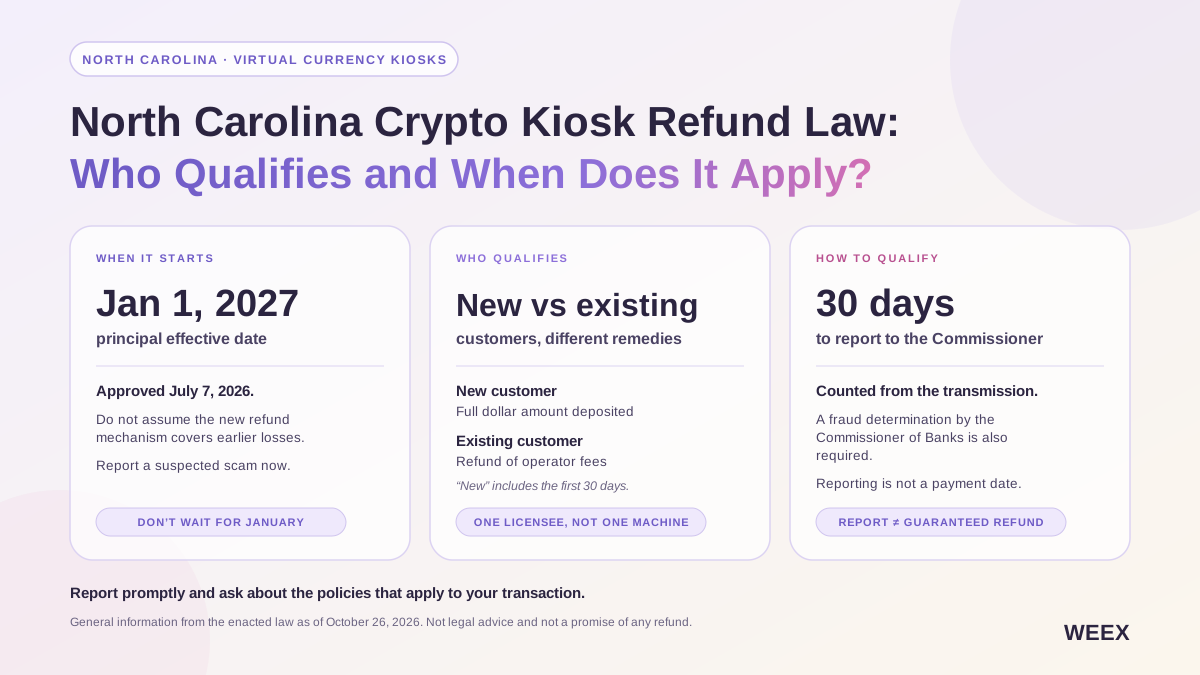
North Carolina’s crypto kiosk refund law creates different remedies for new and existing customers, subject to timely reporting and a fraud determination by the Commissioner of Banks. Eligible new customers receive the dollar amount deposited; eligible existing customers receive operator-fee refunds. The principal provisions take effect January 1, 2027. As of October 26, 2026, readers should not assume that the new refund mechanism already applies to earlier losses. (ncleg.gov)
The most important distinction is between a law being enacted and a refund becoming available in a particular case. A headline promising “crypto ATM refunds” leaves out the questions that determine the outcome: when the transaction occurred, which operator handled it, whether the customer was new, and whether the correct authority received the fraud report.
This guide uses the enacted legislation and current official complaint resources. It separates the future statutory process from the reporting steps victims can take now.
What Is the North Carolina Crypto Kiosk Refund Law?
The Virtual Currency Kiosk Consumer Protection Act, enacted through House Bill 920 as Session Law 2026-45, establishes a regulatory framework for cryptocurrency kiosks operating in North Carolina.
The framework addresses licensing, transaction limits, disclosures, fraud prevention, receipts, customer service, cancellation, and certain refunds. It was approved on July 7, 2026, with the principal provisions scheduled to become effective January 1, 2027. (house.ncleg.gov)
A crypto kiosk is a physical automated machine used to facilitate transactions involving cash and virtual currency. Consumers often encounter these machines in convenience stores or gas stations.
The machine’s familiar appearance can obscure an important difference from ordinary banking. A person depositing cash may be initiating a cryptocurrency transmission to a destination controlled by someone else.
That distinction becomes critical when a scammer supplies instructions, a wallet address, or a payment demand. The transaction may appear to work exactly as instructed while still being fraudulently induced.
The law’s refund provisions address defined circumstances. They do not create a general guarantee against every cryptocurrency loss.
When Does the Law Take Effect?
The principal effective date is January 1, 2027—not the date the legislation was signed.
Section 4 establishes that date, except where otherwise provided, and refers to offenses committed on or after it. Separately, Section 3 requires the Commissioner to establish fraud-determination procedures and implementing rules by that date; that implementation section became effective when the law was enacted.
For someone reading this article in October 2026, that creates two different tasks.
First, report a suspected scam promptly using the available official channels. Second, ask which rules and remedies apply to the particular transaction. Do not postpone reporting while waiting for January.
| Relevant Date | What It Means |
|---|---|
| July 7, 2026 | The legislation was approved |
| October 26, 2026 | Review date for this article; the principal effective date remains in the future |
| January 1, 2027 | Principal effective date and deadline for implementing procedures |
The table explains timing, not an individual eligibility decision. A transaction near the effective date may require review of its specific facts and the regulator’s implementation guidance.
Can Someone Recover a Loss That Happened Before January 2027?
Do not assume that a pre-2027 loss qualifies under the new statutory refund mechanism.
The enacted law does not provide a general promise to reimburse every historical crypto kiosk scam. Its effective-date language is a reason to seek case-specific confirmation rather than treat an earlier loss as automatically covered.
However, “the new mechanism may not apply” is different from “there is no reason to report.”
An operator may have an existing refund policy. A transaction may still be pending. Other consumer-protection issues may also require investigation.
In October reporting, WRAL published operator responses describing current policies alongside preparations for the new law. Those statements show why a voluntary company policy and a future statutory obligation should be evaluated separately. They do not guarantee a refund from either operator.
Ask the operator for its applicable policy in writing and preserve its response. At the same time, use official reporting channels rather than relying solely on the company’s interpretation.
-- Price
Who Qualifies for a Refund?
The refund provisions distinguish between new and existing virtual currency customers.
Under G.S. 53-457, both categories require reporting the fraudulent transmission to the Commissioner within 30 days and a determination of fraud under the Commissioner’s procedures. The customer’s status changes the specified remedy.
| Customer Status at the Transaction | Specified Remedy When Conditions Are Met |
|---|---|
| New customer | Refund of the full dollar amount deposited into the kiosk |
| Existing customer | Refund of fees imposed by the operator |
The definition of “new” is broader than “first transaction ever.” The legislation includes someone with no previous transactions with the licensee and someone whose first transaction with that licensee occurred within the preceding 30 days. Existing customers are defined by a first transaction more than 30 days earlier.
The reference to the licensee matters. Using a different physical machine does not necessarily create a new relationship if the same licensed operator runs both machines.
Conversely, a person’s general experience with cryptocurrency does not by itself answer how the statute classifies their relationship with a particular licensee.
For boundary dates or disputed account histories, retain the first-transaction record and ask the Commissioner how the definition applies.
What Are the Three Different Time Periods Readers Should Understand?
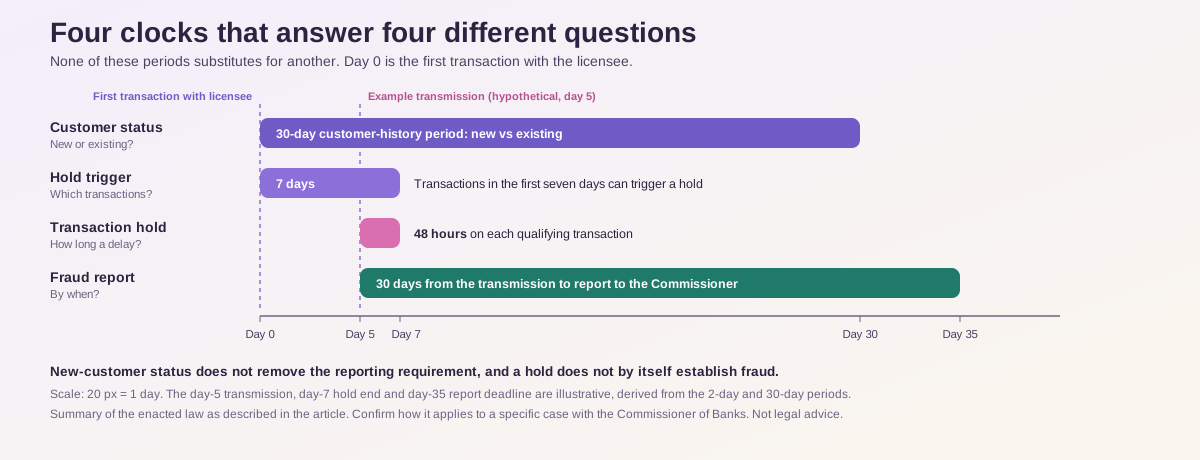
The law involves several clocks that answer different questions. Combining them can cause a consumer to misunderstand either prevention measures or refund eligibility.
The most useful distinction is between the customer-classification period, the transaction-hold trigger, and the fraud-reporting deadline.
| Time Period | What It Addresses | Common Misunderstanding |
|---|---|---|
| 30-day customer-history period | Whether the customer is new or existing | “New” means only the very first visit |
| First seven days after the first transaction | Which transactions trigger the mandatory hold | Every new customer receives a hold for the entire 30-day period |
| 48-hour hold | Delay before a qualifying transaction can be completed | It is a universal chargeback period |
| 30 days from transmission | Reporting fraud to the Commissioner | The deadline starts when the victim discovers the scam |
The hold provision applies to transactions initiated by customers whose first transaction occurred within the past seven days. Each qualifying transaction has its own 48-hour hold.
These clocks do not substitute for one another. Being classified as a new customer does not eliminate the reporting requirement, and a delayed transaction does not automatically establish fraud.
Does Reporting Within 30 Days Mean a Refund Arrives Within 30 Days?
No. The 30-day condition concerns the fraud report, not a guaranteed payment deadline.
The refund provision measures reporting from the transmission. It separately requires the Commissioner’s fraud determination. It does not say that simply submitting a complaint automatically produces payment within that same period.
This has an important practical consequence: do not spend the available time waiting for the operator to finish an internal review before checking the regulator’s reporting process.
Keep separate records of when the transaction occurred, when you contacted the operator, and when you reported to the Commissioner. A company support ticket and a regulator complaint are not interchangeable documents.
If there were multiple transmissions, list them individually. Do not assume that the date of the last payment resets the reporting period for earlier payments.
Where the deadline is close, contact the Commissioner promptly about how to submit the report and provide supporting information. Do not wait until every detail of the scam has been reconstructed.
Where Should Victims Report a Crypto Kiosk Scam?
The enacted refund provision identifies the North Carolina Commissioner of Banks as the authority receiving the report and determining fraud.
The Commissioner’s current Consumer Inquiries and Complaint Information page explains how to check whether a company is regulated and access the online complaint process. It also provides a route for general questions.
The page reviewed for this article describes the general complaint system. It should not be presented as a separately verified, fully implemented 2027 kiosk-refund portal.
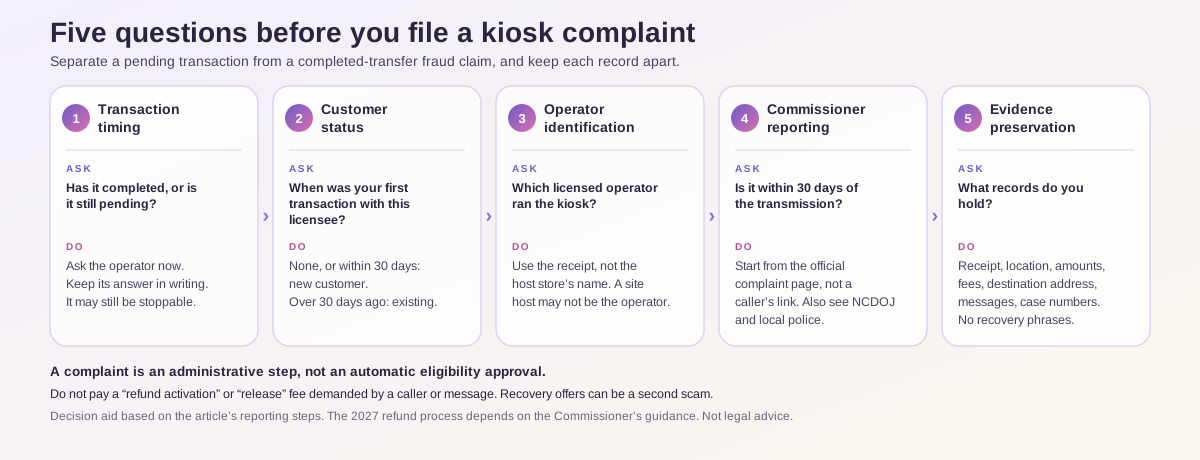
Contact the Kiosk Operator
Use contact information from an authentic receipt or a verified company source.
Ask whether the transaction has completed, whether any hold remains, and whether cancellation or a policy-based refund is available. Request a case number and written confirmation.
This contact can help preserve records and clarify transaction status. It does not replace reporting to the authority identified in the statute.
Use the Commissioner’s Official Complaint Resources
Start from the official complaint-information page rather than a link sent by an unsolicited caller.
Describe the kiosk, operator, transaction, and suspected fraud. Explain that the complaint concerns a virtual currency kiosk and ask how the applicable reporting or fraud-determination process should be followed.
The Commissioner’s general process involves reviewing complaints and obtaining company responses. Filing a complaint is an administrative step, not an automatic eligibility approval.
Report the Scam to Other Appropriate Authorities
The North Carolina Department of Justice complaint page provides consumer complaint options. Local law enforcement may also need a report, particularly where threats or impersonation were involved.
NCDOJ’s own crypto-scam guidance encourages prompt reporting. These additional reports serve useful purposes, but readers should not assume they replace the specific Commissioner-reporting condition.
What Documents Should You Preserve?
A clear record helps separate the underlying scam from the kiosk transaction used to carry it out.
The following is a practical preparation checklist, not a claim that every item is mandatory on a future refund application.
| Record | Why It Helps |
|---|---|
| Kiosk receipt and transaction reference | Identifies the payment and operator |
| Machine location and identifying information | Connects the complaint to the physical kiosk |
| Dollar amount, cryptocurrency amount, and fees | Separates the deposited value from charges |
| Destination address and transaction identifier | Helps identify the recorded transmission |
| First transaction date with the operator | Helps establish the relevant customer history |
| Messages, phone numbers, and payment instructions | Documents how the payment was induced |
| Operator and agency case numbers | Establishes the reporting history |
The law’s receipt provisions anticipate detailed transaction information, including timing, identifiers, addresses, charges, and refund-policy information.
If the receipt is missing, explain that in the report and provide whatever other records are available. Missing one document is a reason to seek help locating evidence, not a reason to delay reporting.
Keep originals and submit copies through official channels. NCDOJ specifically advises providing legible supporting copies and warns that submitted documents may become public records. Avoid including wallet recovery phrases or unrelated sensitive information.
How Would the Rules Work in Realistic Scenarios?
Examples are useful only when their assumptions are explicit. The following situations are hypothetical and assume a transaction to which the new provisions apply.
Scenario 1: A New Customer Reports Promptly
A customer makes their first transaction with an operator and is deceived into sending funds to a scammer. They report the fraudulent transmission to the Commissioner within the required period.
The remaining question is the Commissioner’s determination and the applicable procedure. New-customer status and timely reporting are important conditions, but an article cannot pre-approve the claim.
Scenario 2: A Returning Customer Is Still Within the Initial Period
A customer used the same operator for the first time two weeks earlier.
Calling them a “returning customer” in ordinary conversation does not necessarily make them an existing customer under the law. The statutory customer-history definition controls.
This is why the first-transaction date can matter more than the number of visits.
Scenario 3: An Established Customer Requests a Full Deposit Refund
A customer whose first transaction with the licensee occurred several months earlier reports a fraudulent transmission.
The statutory distinction between deposit refunds and operator-fee refunds becomes important. A full-deposit remedy should not be promised merely because a timely fraud report was submitted.
Other facts or remedies may warrant review, but they should not be invented from a broad headline.
Scenario 4: The Loss Occurred in October 2026
A victim reads about the law after losing money before its principal effective date.
They should report now and ask about applicable existing policies and remedies. Waiting until January would not make the earlier transaction automatically qualify under the new framework.
Can a Pending Crypto Kiosk Transaction Be Cancelled?
The enacted law provides for cancellation with a full and immediate refund when cancellation occurs before completion. This is separate from the fraud-refund process after transmission.
The mandatory hold creates a potential intervention window for qualifying transactions. The operator cannot simply release a held transaction early because the customer requests it; the hold has specific statutory requirements.
For someone who realizes during a pending transaction that they are being scammed, the immediate question is therefore transaction status: Has it actually completed, or can it still be stopped?
Ask the operator directly and preserve its response. Do not rely solely on a caller’s claim that the payment is irreversible or that another deposit is required to fix it.
The general lesson applies before the new provisions take effect as well: contact the operator immediately about a transaction that may still be pending, without assuming the future statutory cancellation right already governs it.
Does the 12% Fee Cap Make a Kiosk Transaction Safe?
No. A fee restriction addresses transaction cost; it does not authenticate a recipient or make a payment request legitimate.
The new framework caps aggregate fees and charges, including spread, at 12% of the relevant transaction value. It also establishes different daily limits for new and existing customers.
These are protections with defined purposes. They should not be interpreted as permission to proceed with a suspicious payment.
For example, a hypothetical $1,000 transmission can still cause a $1,000 loss even if the operator charges no fee at all. Lower costs do not solve the problem of sending value to a scammer.
Likewise, remaining below a daily limit does not prove that a transaction is appropriate. A scammer can request an amount below a regulatory cap.
The better question is whether the payment is genuinely yours to make, to a recipient you independently verified, for a reason that survives scrutiny.
Does the Law Cover Online Crypto Exchange Losses?
Do not assume that a rule written for physical virtual currency kiosks applies to ordinary online exchange trading.
A loss from market-price movement, a disputed online withdrawal, and a fraudulently induced kiosk transmission involve different facts. The product and transaction must be identified before any remedy can be assessed.
The legislation also distinguishes a kiosk operator from a business that merely supplies space for a third-party machine. The gas station’s name alone may therefore be insufficient to identify the relevant operator. (ncleg.gov)
For readers evaluating online services, the useful parallel is verification. The WEEX Trust Center provides access to WEEX security and transparency information, while the WEEX Contact Verifier helps check purported WEEX channels.
Those resources serve a different purpose from North Carolina’s kiosk-refund framework. They do not establish that a kiosk loss is covered by WEEX or that a particular service is available in a particular jurisdiction.
What If Someone Offers to Recover the Money for a Fee?
Treat the recovery offer as a separate potential scam.
Someone who knows about your loss may claim to represent an investigator, government office, exchange, or recovery company. Knowledge of the incident does not prove that identity.
North Carolina’s Department of Justice has warned that people who have already lost cryptocurrency can be targeted again by supposed recovery services.
Use contact information obtained independently from official websites. Do not pay an unexpected “refund activation,” “verification,” or “release” demand simply because the sender cites the new law.
If someone claims to represent WEEX, check that claim through the official verifier. If they claim to represent the Commissioner or NCDOJ, return to the agency’s own published contact route.
A law creating potential refund rights does not make every message advertising those rights authentic.
WEEX Editorial View
North Carolina’s new framework is meaningful because it adds specific responsibilities around a payment channel frequently used in reported scams. Its practical value, however, depends on consumers understanding the conditions.
The most dangerous simplification is “report a crypto scam and get all your money back.” That statement ignores timing, customer classification, the designated reporting authority, and the fraud-determination process.
The better approach is concrete: identify the operator, preserve the transaction record, report promptly, and distinguish a pending cancellation from a completed-transfer fraud claim.
For losses predating January 2027, seek help now rather than waiting for a future effective date. For later transactions, use the Commissioner’s current implementation guidance instead of relying on an old headline or an operator’s verbal assurance.
FAQ
1. When Does North Carolina’s Crypto Kiosk Refund Law Take Effect?
The principal provisions take effect January 1, 2027. The section directing the Commissioner to establish implementing procedures became effective when the legislation was enacted.
2. Does Every Crypto ATM Scam Victim Receive a Full Refund?
No. The law distinguishes new customers from existing customers and requires timely reporting and a fraud determination. The specified remedies differ between the two customer categories.
3. Does the 30-Day Deadline Start When I Discover the Scam?
The refund provision measures the reporting period from the transmission. Do not assume that discovering the scam later restarts that period.
4. Is Reporting to the Kiosk Company Enough?
The statutory condition specifies reporting to the Commissioner of Banks. Contacting the operator can be important, but it should not be treated as a substitute for the required regulatory report.
5. Can I Claim a Refund for Money Lost Before January 2027?
Do not assume that the new mechanism covers earlier losses. Report promptly and ask the operator and appropriate authorities about the policies and remedies applicable to your transaction.
Sources
| Source | Material Reviewed | Date |
|---|---|---|
| North Carolina Session Law 2026-45 | Enacted legislation, definitions, receipts, and implementation provisions | Approved July 7, 2026; checked October 26, 2026 |
| G.S. 53-457 | Refund conditions, cancellation, limits, and fees | Checked October 26, 2026 |
| Commissioner of Banks: Complaint Information | Current official complaint and inquiry routes | Accessed October 26, 2026 |
| NCDOJ: File a Complaint | Consumer reporting and supporting-document guidance | Accessed October 26, 2026 |
| WRAL: Crypto ATM Scam and Operator Responses | Recent reporting and company-policy distinctions | Published October 19, 2026 |
| Sheppard: North Carolina Kiosk Act | Regulatory overview and operational requirements | Published August 20, 2026 |
| NCDOJ: Cryptocurrency Recovery Scams | Secondary-scam warning | Accessed October 26, 2026 |
This content is provided for general informational purposes only and doesn't constitute financial, investment, legal, or tax advice. Any events, rewards, online promotions, or related information mentioned herein should not be considered a recommendation, solicitation, or invitation to purchase, sell, trade, or otherwise deal in any crypto assets. Crypto assets are highly volatile and may result in loss. The availability of WEEX services, products, and related events may vary by region. You are responsible for ensuring that your participation is in accordance with applicable local laws and regulations.
You may also like

[Bitcoin $0 Controversy②] "$0 is an Exaggeration"... Reasons Wall Street Disagrees
[ETH Letter] Meritz Securities Reviews Tokenization of Korean Securities Based on OP Stack

Progressive Party Opposes Further Delay of Cryptocurrency Income Tax

JPMorgan's Tokenized Fund on Solana: What MONY and JLTXX Mean for Institutional Adoption of RWA

Real and Fake Cryptocurrency Market Makers: What Makes a Market Maker Legitimate?

Michaël van de Poppe sees four crypto trends: AI, Ethereum, Sui, and digital assets

Coppock Curve and Crypto Trading: How to Use the Trend Reversal Indicator

Bitcoin Records U.S. Constitution Again... This Time with a Mysterious Code

Hedge funds hold $2 trillion in US debt, but their next trade could require fewer bonds
Weekly: $68,000 Theft from Ukrainian in Trust Wallet, Circle's Lawsuit Against Trump Over $2 Billion in UAE, and Historic Solana Update

ZachXBT Accuses CoinDCX of Losing $16 Million in Client Funds

NYSE’s owner is backing 24/7 stock tokens without Wall Street’s usual price rules
JPMorgan Now Offers Two Tokenized Money Market Funds on Solana
Follow the Money: $630 Million for Strive, Tether Activity and Attention to CeFi

HTX Research Analyst Chloe: Despite Significant Net Inflows into Bitcoin Spot ETFs, Macroeconomic Data Suppresses Rebound Potential
Killa: Frequent Short-term Trading Risks Missing Major Market Movements, Patience in Holding Positions is Important
China's fiscal revenue rose 5.1% by September, but land sales continue to decline

90% of Revenue from Meme Coins, Yet Valuation Rivals Pump: What Should Meteora Be Worth?
Former FTX Executive Slams Netflix's New Series: Turning Financial Fraud into a 'Romantic Film' is Absurd

Ripple teams up with $10B payments firm Arf to expand RLUSD use on XRPL

One billion dollars in three days is not enough. Bitcoin faces a significant challenge

WEEX Exclusive:Major Indexes Close Higher; Focus on TSLA, META Stock Earnings | WEEX TradFi Daily(October 22, 2026)
Major Indexes Close Higher; Focus on TSLA, META Stock Earnings | WEEX TradFi Daily(October 22, 2026)
The three major indexes closed higher on October 21, led by the Nasdaq. SpaceX beat earnings expectations and disclosed AI-business revenue; merger discussions with Tesla also helped lift AI and crypto-related stocks. Bitcoin traded near $84,000 and Ethereum near $2,470. LIT led majors on compliance-license expectations. On October 22, investors will watch Procter & Gamble, Southern Copper and Union Pacific before the open, followed by Western Digital and Newmont after the close.

Irish drug lord’s lost Bitcoin fortune comes back to life as $41 million moves to Coinbase

ZachXBT Reports on Cryptocurrency Laundering via FreedomXMR on Hyperliquid

Willy Woo: Good Time to Accumulate Bitcoin

Tech and AI: Hedge Funds Reduce Exposure at Unprecedented Rate in Ten Years

The Qubic network is back in operation after the hacking of users
Crypto rallies point to slower USDC growth and faster USDT growth, study finds
North Korea-linked SquidSquad suspected in $2.84M BNB Chain theft
[Bitcoin $0 Controversy②] "$0 is an Exaggeration"... Reasons Wall Street Disagrees
[ETH Letter] Meritz Securities Reviews Tokenization of Korean Securities Based on OP Stack
Progressive Party Opposes Further Delay of Cryptocurrency Income Tax
JPMorgan's Tokenized Fund on Solana: What MONY and JLTXX Mean for Institutional Adoption of RWA
Real and Fake Cryptocurrency Market Makers: What Makes a Market Maker Legitimate?
Michaël van de Poppe sees four crypto trends: AI, Ethereum, Sui, and digital assets
Contents
Latest articles




Latest coin listings on WEEX


