
What is Delta Hedging: A Method to Neutralize the Risks of Spot Holdings

 Prefer us on Google


Delta hedging is a technique where an opposite position is held in the same size so that the price exposure of two positions offsets each other. Traders with physical holdings can sell an equivalent amount of futures to bring the overall direction of their portfolio closer to neutral, regardless of which way the market moves. It is akin to cruise control; it maintains a set state, but only as long as the underlying conditions do not change.
Overview of Delta Hedging
|--------------|-------------------------------------------------------------------| | Indicator | Details | | Definition | Holding an opposite position according to delta to offset directional exposure | | Rule | Hedge size = Position delta × Exposure. A 1:1 combination of physical long and short-term futures is the basic form of delta neutrality. | | Purpose | To separate funding costs and premium elements from price direction. | | Unknowns | It relates to gamma. Delta is merely an instantaneous value, and hedges involving non-linear positions can quickly break down as prices move. | | Display on Phemex | Open positions in perpetual futures. | | Common Misunderstanding | The misconception that "delta neutral" means "no risk." |
As of the end of trading on Friday, September 4, ETH was priced at $2,456.28, down 2.04%. This aligns with CoinGecko's Ethereum page within rounding limits. If you hold 10 coins, that single trade would result in a fluctuation of $512. Delta hedging is a standard approach for traders who want to continue holding while mitigating the impact of price movements. However, it is often overlooked that this hedge is merely a snapshot, incurs costs to maintain, and may not be effective if the carry of perpetual futures exceeds other costs.
Delta indicates how much the value of a position reacts to a one-unit change in the underlying asset. A single coin held physically has a delta of exactly 1.00, meaning a $1 increase results in a $1 profit. Long perpetual futures also have a delta of +1.00, while shorts have -1.00. Options are interesting because call deltas range from 0 to 1, and put deltas range from 0 to -1, making them model outputs rather than fixed values. The Cboe Options Institute is where many traders first encounter this concept.
Delta hedging involves adding a position with a delta that offsets the delta already held. The Nasdaq glossary succinctly describes this.
First, it is essential to clarify a point that can be easily confused. The term delta also refers to order flow indicators like cumulative volume delta, but that is a separate tool and unrelated to hedging.
The situations that necessitate this technique are clear. You may not want to part with coins due to tax implications from selling, the collapse of a staking position, or a desire to maintain a hypothesis you still believe in, while also wanting to avoid the next downturn. Hedging allows for a degree of coexistence of both.
How to Calculate the Hedge Ratio?
Sum all the deltas you hold and take an opposite position of the same size.
Suppose you hold 10 ETH. With a delta of 1.00 per coin, the position delta is +10. At the closing price on Friday, September 4, the nominal value is $24,562.80. If you short 10 ETH worth of perpetual futures with a delta of -1.00, the position delta becomes -10, resulting in a net of zero.
Let’s check this with actual price movements. If ETH drops to $2,200, the physical holding incurs a loss of 10 × $256.28, which equals $2,562.80, but the short side gains the same amount. The two positions offset each other, and excluding costs, the overall position is flat.
Partial hedging is simply calculated as a ratio. If you short 6 ETH against 10 ETH, the ratio is 0.6, resulting in a net delta of +4. With the same price movement, the loss would be $1,025.12 instead of $2,562.80, allowing you to retain 40% of the upside.
If the two positions are in different assets, it becomes more complex. Shorting ETH against an altcoin that does not have its own perpetual contract will deviate significantly from a ratio of 1.0. Here, you would use beta against ETH, which indicates how much it moves when ETH moves by 1%. If it reacts by 1.4% to a 1% movement in ETH, you would short 1.4 times the nominal amount. Beta is based on historical data, explaining relationships that have already occurred.
What is a Delta Neutral Position?
A delta neutral position is when the net delta of all positions combined is zero. Small fluctuations in the underlying asset will keep the overall positions nearly in the same place.
However, this does not mean "no risk." The difference in interpretation between these two meanings is where most losses lie. Neutrality describes only one risk factor. Funding costs continue, the spread between physical and contracts may move unfavorably, and positions with margin may be liquidated. Additionally, counterparty risk, storage risk, and stablecoin risk remain.
Why is Delta Hedging Necessary to Rebalance?
First, we should start with a more accurate explanation. A combination of a 1:1 physical long and a linear perpetual short has no gamma. Since both positions move similarly with price, if they are neutral at $2,456, they remain neutral even at $3,000, and no rebalancing is needed.
However, if one position is replaced with a non-linear one, the delta will no longer remain static. Gamma indicates how much delta changes in response to price fluctuations.
Let’s look at this numerically. If you hold 10 ETH and sell calls with a delta of 0.40 for all 10, the short call side becomes -4.00, and the portfolio delta is +6. You would then short 6 ETH worth of perpetual futures to flatten it. Next, if ETH rises and the call delta increases to 0.55, that increase is gamma. The call side becomes -5.50, resulting in a net of -1.50. The positions you set up to aim for neutrality are now short in a rising scenario.
To bring it back to flat, you would need to buy back 1.5 contracts at a higher price. Then, as the price drops and the call delta returns to 0.40, you would become long by 1.5 contracts and sell 1.5 contracts at a lower price.
This means buying high and selling low, but that is what the hedge dictates.
This is negative gamma, a structural cost associated with shorting options. It is similar to a thermostat in a drafty room that continuously turns heating on and off to maintain a constant temperature, consuming fuel each time. For an understanding of how option pricing works, the composition of option prices can be referenced.
How frequently to rebalance is up to the trader, but costs will arise regardless of the direction. Narrowing the tolerance will lead to frequent payments of spreads and fees, while widening it will incur drift. Costs fluctuate with the volatility of the underlying asset. The more volatile the price movements, the more likely you are to have to rebalance at undesirable prices.
How Do Traders Delta Hedge with Perpetual Futures?
Perpetual contracts have become the standard hedging method for cryptocurrencies for practical reasons. With no expiration, roll management is unnecessary, and the structure of perpetual futures keeps prices close to the physical level. USDT-denominated linear perpetuals have a clear characteristic of -1.00 delta per contract, making size adjustments straightforward.
Hedging is designed based on the number of coins rather than the amount of money. If you short with a fixed amount, a gamma-like discrepancy can re-enter a position that previously had no gamma. If you short a fixed number of coins, the hedge remains accurate regardless of price changes. Conversely, if you short a fixed amount of $24,562, discrepancies will arise with each price fluctuation, necessitating corrective trades that buy high and sell low, similar to options hedging.
The second point directly relates to actual funding costs. Since the holdings in spot and the margin for futures are usually in separate accounts, consider a scenario where ETH rises by 30% in a week. The short side accumulates unrealized losses against the collateral in the futures wallet, but the offsetting profits are in the spot account and do not immediately reflect in the margin. Even if it appears neutral, it can be liquidated on the hedge side.
The choice of which exchange and method to hedge is a separate issue, which is explained in detail regarding cryptocurrency hedging.
How much does delta hedging actually cost?
There are four types of costs, each with completely different characteristics.
|------------|--------------------------------|--------------------------|
| Cost | Factor | Can it be known in advance? |
| Execution Cost | Number of rebalances, spreads, fee rates | Yes, exchanges publish this |
| Rebalancing Cost | Realized volatility and how narrow the tolerance is | No, it can only be known afterward |
| Carry (Financing) | Holding period and which side the position is skewed towards | No, and it can vary between receiving and paying |
| Basis | Spread between spot and perpetual at the time of opening and closing the position | Partially possible, the starting spread can be checked |
Execution costs are typically the smallest in many hedges and are the first item everyone counts. Rebalancing costs are not fees but realized losses incurred from trading in the opposite direction, occurring only when part of the position is nonlinear.
Carry ultimately influences the final outcome. Since perpetual contracts have no expiration, a mechanism is needed to link them to the spot. This role is played by financing, which is not paid to the exchange but is periodically exchanged between traders on both sides. When the contract price exceeds the spot, the long pays the short, and when it falls below, the short pays the long. A hedger shorting perpetuals will receive in the former case and pay in the latter. The CFTC's glossary of futures terms organizes basic terminology.
Here, financing rates and schedules are not listed intentionally. Financing is set for each contract, re-listed in the exchange's prescribed cycle, and changes based on position status. The only number that affects trading is the live value displayed on that contract at the time of determining size.
The form differs, and those differences determine the outcome. Execution costs are proportional to the number of times the position is touched, rebalancing costs are proportional to the price movement, and carry accumulates over time. It occurs even when nothing is done and can exceed the total rebalancing costs over several weeks. Moreover, the direction is not one-sided. In a situation where longs are crowded, a short perpetual hedge can yield profits just by holding. Conversely, in a situation where shorts are crowded, the same hedge incurs costs. Still, operators may refer to it as market neutral.
What are the risks of delta hedging?
Liquidation on the hedge side. The failures mentioned above are independent risks. Even with a position in the correct direction, it can disappear. While it may appear neutral across two accounts, it is not neutral within a single margin engine.
Carry becoming larger than the reduced risk. Even if hedged against downside risk, costs accumulate based on the holding days. In the long term, this does not automatically result in a favorable trade.
Basis and correlation. Hedging one asset with a proxy asset introduces another variable. The assumed beta is valid until it stops functioning, but it tends to break in situations that require hedging. For further learning, the Options Industry Council is a good reference.
Inability to execute when needed. Spreads widen, and liquidity tends to decrease, occurring precisely in markets that require rebalancing. The modeled costs often assume a calm market that is actually difficult to trade in.
Tax treatment. In many jurisdictions, hedging may be considered a taxable derivative transaction even if no shares are sold, and this treatment depends on the reporting system of the jurisdiction.
Frequently Asked Questions
Is delta hedging the same as shorting?
No. Shorting is a directional trade aiming for price declines, while delta hedging adjusts the scale against what is already held to reduce overall sensitivity to price movements. Although they may appear to have the same delta, the liquidation structures are significantly different.
Can delta hedging be done without options?
Yes. Many cryptocurrency traders do not use options. A combination of spot longs and linear perpetual shorts serves as a hedging strategy in many operational settings. Both are linear, so there is no gamma to chase. Options come into play when seeking profit and loss shapes that cannot be created with linear combinations.
How often should delta hedging be rebalanced?
In professional operations, it is common to manage based on tolerance rather than time. For example, set a delta tolerance of ±0.5 coins and only trade when the position falls outside that range. Rebalancing at fixed times incurs fees even on days when there was no movement.
Does delta hedging work during a crash?
It works in terms of price. That is the purpose. However, during a crash, spreads widen, financing conditions can change rapidly, and margin shortages are more likely to occur on positions that are most undesirable. When hedging with proxy assets, correlations are likely to break first.
-- Price
Conclusion
If you design hedges based on the number of coins rather than the amount, you can maintain them without further adjustments in terms of price. However, costs cannot be maintained. Before starting, confirm the following three points for your contract: the live financing on the short side, the current spread between spot and perpetual, and the margin required if the price moves 20% unfavorably against the short. If you cannot explain the carry cost for one month at the rate currently displayed, it is not a hedge but a state of paying confirmation costs.
This content is provided for general informational purposes only and doesn't constitute financial, investment, legal, or tax advice. Any events, rewards, online promotions, or related information mentioned herein should not be considered a recommendation, solicitation, or invitation to purchase, sell, trade, or otherwise deal in any crypto assets. Crypto assets are highly volatile and may result in loss. The availability of WEEX services, products, and related events may vary by region. You are responsible for ensuring that your participation is in accordance with applicable local laws and regulations.
You may also like

HTX Research Analyst Chloe: Despite Significant Net Inflows into Bitcoin Spot ETFs, Macroeconomic Data Suppresses Rebound Potential

Killa: Frequent Short-term Trading Risks Missing Major Market Movements, Patience in Holding Positions is Important

China's fiscal revenue rose 5.1% by September, but land sales continue to decline

90% of Revenue from Meme Coins, Yet Valuation Rivals Pump: What Should Meteora Be Worth?
Former FTX Executive Slams Netflix's New Series: Turning Financial Fraud into a 'Romantic Film' is Absurd

Ripple teams up with $10B payments firm Arf to expand RLUSD use on XRPL

One billion dollars in three days is not enough. Bitcoin faces a significant challenge
WEEX Exclusive:Major Indexes Close Higher; Focus on TSLA, META Stock Earnings | WEEX TradFi Daily(October 22, 2026)
Major Indexes Close Higher; Focus on TSLA, META Stock Earnings | WEEX TradFi Daily(October 22, 2026)
The three major indexes closed higher on October 21, led by the Nasdaq. SpaceX beat earnings expectations and disclosed AI-business revenue; merger discussions with Tesla also helped lift AI and crypto-related stocks. Bitcoin traded near $84,000 and Ethereum near $2,470. LIT led majors on compliance-license expectations. On October 22, investors will watch Procter & Gamble, Southern Copper and Union Pacific before the open, followed by Western Digital and Newmont after the close.

Irish drug lord’s lost Bitcoin fortune comes back to life as $41 million moves to Coinbase

ZachXBT Reports on Cryptocurrency Laundering via FreedomXMR on Hyperliquid

Willy Woo: Good Time to Accumulate Bitcoin

Tech and AI: Hedge Funds Reduce Exposure at Unprecedented Rate in Ten Years

The Qubic network is back in operation after the hacking of users

Crypto rallies point to slower USDC growth and faster USDT growth, study finds
North Korea-linked SquidSquad suspected in $2.84M BNB Chain theft

Putting Childhood on the Trading Table: TCG May Be the Closest Moment for Young People to Get Rich

Kraken’s $80 stablecoin fee gap exposes hidden costs

Justin Sun Sells 80-90% of His ETH: Bitcoin Warning
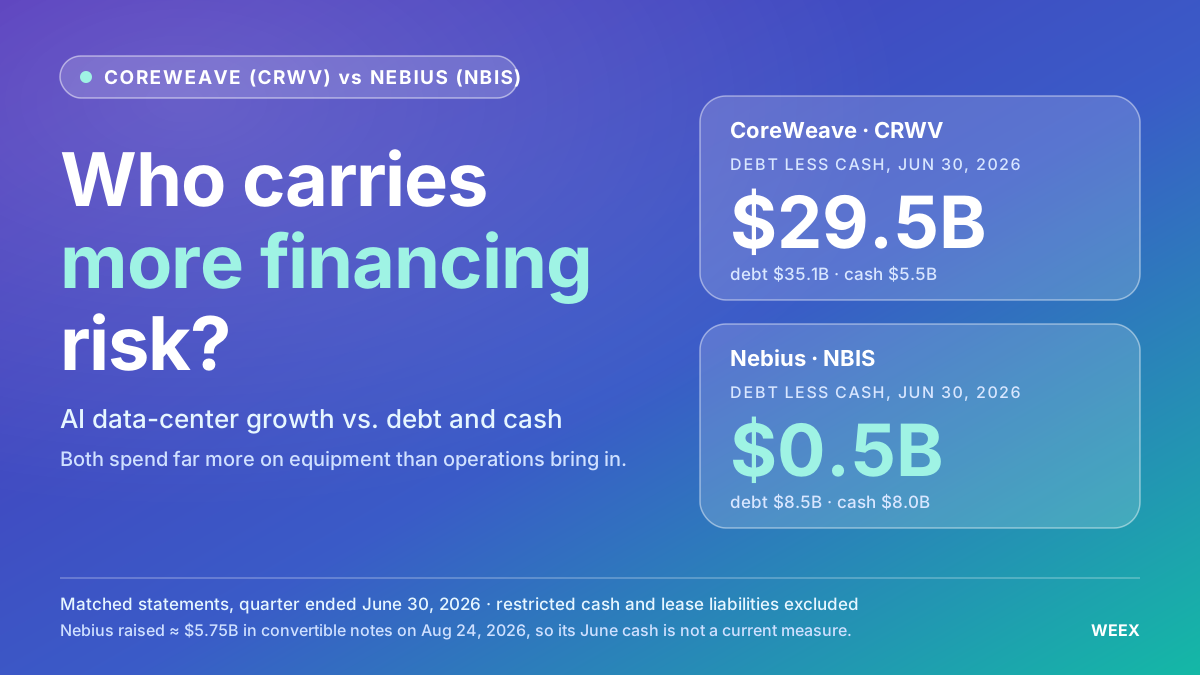
CoreWeave vs. Nebius Stock: Which AI Cloud Business Faces Greater Financing Risk?
Compare CoreWeave and Nebius stock through debt, cash flow, customer prepayments and dilution to assess which AI cloud business faces greater financing risk.

Cryptocurrency Exchange Bitget Suddenly Exits Russia. What Happened
EU bans cash payments over €10,000 starting July next year
Country risk near 680 points: why Argentine bonds fall despite international relief

Bitcoin at $100,000 in 2026: Bitwise Remains Optimistic Despite Inflation

Bitcoin Wallet Moves 411.45 BTC Worth 33400000 Dollars Amid Lawsuit

Bank of America predicts a hit of up to 10% on European stocks due to risks in the AI cycle

Fake Demand, Real Losses: How Popular Crypto Schemes Work

BNB Chain claims 42.6% of tokenized stock market, beating Ethereum and Solana
Freezing and Confiscation of Cryptos: Europe Strengthens Cooperation Against Criminal Networks
10-Year Yield Plummets 17 Basis Points in a Week! AI Trading Turmoil Rekindles Safe-Haven Attributes of U.S. Treasuries
HTX Research Analyst Chloe: Despite Significant Net Inflows into Bitcoin Spot ETFs, Macroeconomic Data Suppresses Rebound Potential
Killa: Frequent Short-term Trading Risks Missing Major Market Movements, Patience in Holding Positions is Important
China's fiscal revenue rose 5.1% by September, but land sales continue to decline
90% of Revenue from Meme Coins, Yet Valuation Rivals Pump: What Should Meteora Be Worth?
Former FTX Executive Slams Netflix's New Series: Turning Financial Fraud into a 'Romantic Film' is Absurd
Ripple teams up with $10B payments firm Arf to expand RLUSD use on XRPL
Contents
Latest articles


Latest coin listings on WEEX


