
Robinhood Predicts Market Gains, But Crypto Revenue Halves

 Prefer us on Google


Robinhood's transformation has made substantial progress.
Written by: SoSoValue Research
Robinhood's Q3 financial report shows a stark divergence: options, prediction markets, and on-chain business drove revenue to a new high, while crypto trading revenue was still halved compared to the same period last year, and profits failed to recover year-on-year growth. The company is gradually expanding its revenue sources, but the efficiency of converting new trading activities into profits has become the core test of this financial report.
Q3 revenue reached $1.424 billion, an 11.8% year-on-year increase and an 8.9% quarter-on-quarter increase, slightly below the market expectation of about $1.43 billion; net profit was $476 million, a 14% year-on-year decrease. After the earnings report was released, the stock price fell about 7% in after-hours trading. From the revenue structure and subsequent operational trends, market concerns are focused on the quality of growth: high-growth businesses have begun to fill the gaps left by older businesses, but the incremental revenue still needs to absorb the expansion of expenses, declining interest income, and pressure on trading monetization.
Unrealized Losses Amplified Profit Declines, Core Earnings Still Lack Year-on-Year Growth
Q3 GAAP earnings per share (EPS) was $0.51, a 16% year-on-year decrease, which includes a $67 million unrealized loss primarily related to valuation changes in Robinhood Ventures Fund I, impacting EPS by about $0.07. Excluding this impact, the EPS would be approximately $0.58, down about 5% from $0.61 in the same period last year.
The company disclosed a new non-GAAP adjusted EPS for the first time this quarter, which, after excluding investment gains and losses, was $0.60, a 3% year-on-year decrease but a 20% increase from $0.50 in the previous quarter. This change indicates that the quarter-on-quarter operational performance is improving, while reported profits are significantly disturbed by fluctuations in investment valuations.
Expenses and tax burdens also suppressed profit performance. Quarterly operating expenses increased by 16% year-on-year to $739 million, outpacing revenue growth; credit loss provisions rose from $26 million to $71 million, primarily accompanying the expansion of credit card loan business. Pre-tax profit only decreased by about 1% year-on-year, but income tax expenses rose from $78 million to $149 million, further amplifying the decline in net profit.
Adjusted EBITDA grew by 9% year-on-year to $808 million, with a profit margin of about 57%, slightly lower than the 58% in the same period last year. Robinhood still maintains strong profitability, but the record revenue has not led to an expansion in year-on-year profit margins, and the growth investment in new businesses is also entering the cost side.
Crypto Trading Volume Rebounds, Revenue Recovery Relies on On-Chain Increment
The year-on-year pressure on crypto business remains prominent. Q3 crypto revenue was $120 million, a 55% year-on-year decrease; nominal trading volume was $49.8 billion, a 38% year-on-year decrease. Among them, Robinhood's own app trading volume decreased by 48% year-on-year, Bitstamp decreased by 28%, and the contraction in retail trading was even more pronounced.
However, quarter-on-quarter data showed recovery: total trading volume increased by 23% compared to Q2, with the own app growing by 13% to $20.6 billion, and Bitstamp increasing by 32% to $29.2 billion. From July to September, monthly trading volume rebounded from $10.9 billion to $17.5 billion and $21.4 billion, with trading activity improving month by month.
But there is a gap between the rebound in trading volume and revenue growth. Excluding contributions from Robinhood Chain, Q3 crypto trading revenue was $94 million, a 6% decrease from $100 million in Q2; revenue from the own app fell from $94 million to $88 million, while Bitstamp's revenue remained at $6 million. Ultimately, the $26 million net income added by Robinhood Chain drove a 20% quarter-on-quarter growth in total crypto revenue.
Management explained on the conference call that the comprehensive monetization rate of the crypto business was affected by the increased proportion of stablecoin product Robinhood Earn, which has a lower monetization level than regular crypto trading.
Thus, the crypto business currently faces changes in both demand and structure: retail trading remains below last year's highs, and new activities are increasingly coming from institutions, stablecoins, and on-chain products. The assets and customers covered by the platform are broader, but the revenue contribution per unit of trading volume has also changed accordingly. High interest rates, ongoing capital outflows, and geopolitical uncertainties continue to suppress risk appetite for crypto, which remains a significant constraint on the recovery of retail spot business.
Prediction Markets Nearly Offset Crypto Gap, Options Remain Revenue Pillar
Prediction markets have become an indispensable part of Robinhood's revenue structure. Q3 event contract revenue reached $173 million, exceeding six times that of the same period last year, with a quarter-on-quarter growth of 11%; contract trading volume reached 16.4 billion contracts, exceeding seven times that of the same period last year, with a quarter-on-quarter growth of about 21%. Among them, Rothera contributed $28 million in revenue.
In absolute terms, prediction market revenue increased by about $146 million year-on-year, while crypto revenue decreased by about $148 million, with the two nearly offsetting each other. The prediction market has played an important role in filling revenue gaps, but its rapid growth is primarily used to fill the void left by the crypto business.
Another pillar driving trading-related revenue growth of 19% year-on-year to $867 million is options: revenue grew by 31% year-on-year to $399 million, accounting for about 46% of trading-related revenue; stock trading revenue grew by 41% year-on-year to $121 million. Business diversification has already made a tangible contribution, reducing Robinhood's reliance on a single crypto cycle.
The growth quality of the prediction market itself is also worth noting. Management disclosed that the proportion of non-sports contracts increased from about 15% in the previous quarter to 30%; contracts related to financial events are still awaiting final approval and preparation for launch. Financial event products are expected to leverage the existing stock and options customer base to expand cross-trading demand.
Meanwhile, the quarter-on-quarter growth rate of event contract trading volume outpaced revenue growth, with options trading volume increasing by 48% year-on-year, also faster than the 31% revenue growth. More trading is supporting business scale, but changes in product structure and pricing will affect how much profit these increments ultimately contribute.
-- Price
Robinhood Chain and AI Agents Begin to Provide New Revenue Paths
Robinhood Chain is one of the new businesses with the clearest commercialization progress this quarter. The company disclosed that the mainnet launched in its first quarter generated over $80 billion in DEX trading volume and over $50 million in on-chain fees, ranking among the top five chains globally in terms of revenue and trading volume; the confirmed related net income was $26 million, accounting for about 22% of the quarter's crypto revenue.
This contribution has already had financial significance. Robinhood expands its trading scope through its own chain, tokenized assets, and perpetual contracts, gradually extending from retail trading entry to trading infrastructure. Even if some customers shift to the on-chain market, the company still has the opportunity to continue participating in their trading activities and generating revenue.
AI agent trading is still in an earlier stage. Currently, about 200,000 customers have opened Agentic Trading accounts, cumulatively generating over $1.6 billion in nominal trading volume. Its commercial value mainly lies in lowering the execution threshold for strategies, increasing trading frequency, and promoting the use of more asset classes on the platform.
These two paths expand trading scenarios and tools, but subsequent profit contributions still depend on sustained activity, fee levels, and customer acquisition and technology investments. On-chain business has already begun to supplement current revenue, while AI agent trading needs to further prove that it can create stable new demand and revenue.
Customer Assets Continue to Grow, Active Users and Deposit Speed Show Divergence
Robinhood's customer asset base continues to expand. Q3 total platform assets grew by 19% year-on-year to $396 billion, the number of depositing customers grew by 7% to 28.7 million, Gold subscription users grew by 34% to about 5.2 million, and the subscription penetration rate reached 18%. Retirement account assets grew by 51% year-on-year to $36.6 billion, also indicating that long-term capital business is accumulating scale.
However, quarterly net deposits fell from $21.7 billion in Q2 to $15.7 billion, and monthly active users dropped to 13 million, a decrease of 800,000 year-on-year and 1.1 million from the previous quarter. The divergence between asset growth, paid user growth, and overall active user numbers means that Robinhood currently relies more on customer asset retention and deep usage to drive revenue.
From October until the earnings report was disclosed, net deposits exceeded $13 billion, of which about $6 billion came from the Dell family's investment in the
This content is provided for general informational purposes only and doesn't constitute financial, investment, legal, or tax advice. Any events, rewards, online promotions, or related information mentioned herein should not be considered a recommendation, solicitation, or invitation to purchase, sell, trade, or otherwise deal in any crypto assets. Crypto assets are highly volatile and may result in loss. The availability of WEEX services, products, and related events may vary by region. You are responsible for ensuring that your participation is in accordance with applicable local laws and regulations.
You may also like

Morpho RWA deposits pass $2B as loans approach $900 million

Key Institutional Prerequisite for Tokenization: Issuer Authorization

Kalshi Discusses User Protection Measures with Regulators, Willing to Raise Participation Age to 21

A New Wave of TGE? 19 Projects Expected to Launch Intensively in Q4

OCC Finalizes Stablecoin Issuance Guidelines in the U.S.

Reviewing the US, India, and South Korea: How Retail Investors Ignite the Options Market?

Looking Ahead to Tonight's Federal Reserve Meeting: A Pause in Rate Hikes in October is Almost Certain, How It Affects December Rate Hike Probabilities Becomes the Focus

On-Chain Options Blue Ocean: The Real Battlefield is in Retail Distribution

Bitcoin: Small Holders Leave, Big Buyers Step In

Bitcoin: Hyperliquid Whales Go Short for the First Time Since March

Why JPMorgan Raised the Target Price for Yushu Technology to 995 Yuan

Crypto-Backed Loan Liquidation: Should You Repay or Add Collateral?
Facing crypto-backed loan liquidation? Compare repayment and collateral top-ups using equal budgets, LTV calculations, stress tests and protection limits.

Turbulent Middle Eastern Crypto Market Welcomes Leadership Change

Ritual Raises $30 Million to Launch Token: AI Game Changer or Retail Investor Trap?

Global Markets in the Last 24 Hours: Brent Oil Reaches $115.81, Bitcoin Drops to $79,818

The Mismatch Between Capital Frenzy and Deployment Economics in the Embodied Industry Clock Cycle
One Week Countdown to Midterm Elections! Will Crypto Change?

Bitcoin at $90,000: The $68 Million Bet on the U.S. Midterm Elections

BisonFi: How an Aggregator Captured Orders with Over $2 Billion in Weekly Trading Volume?

Anthropic IPO Filing Lifts AI Sentiment; BTC Holds Near $80,000 | WEEX TradFi Daily (October 27, 2026)
All three major indexes closed higher on October 26. Anthropic formally filed for a listing, rekindling AI speculation; the Philadelphia Semiconductor Index rose about 3% on the day, and Tesla reached a more-than-three-month high. Bitcoin was near $80,200, down for three consecutive weeks and testing $80,000 for a third time. Local assets plunged after the election result. The October 27 focus is the opening of the Federal Reserve meeting and earnings from Visa, PayPal and others.

WEEX Exclusive:Anthropic IPO Filing Lifts AI Sentiment; BTC Holds Near $80,000 | WEEX TradFi Daily (October 27, 2026)
How Optimism’s draft manual silently strips tokenholder elections

Tom Lee Did It Again. Bitmine Spent $24 Million on Ethereum, but Purchases Are Decreasing

Miden Partner Mainnet Launches, Plans Transition to Public Mainnet in Coming Months
Elon Musk's Grand Scheme to Undermine New Cloud Providers
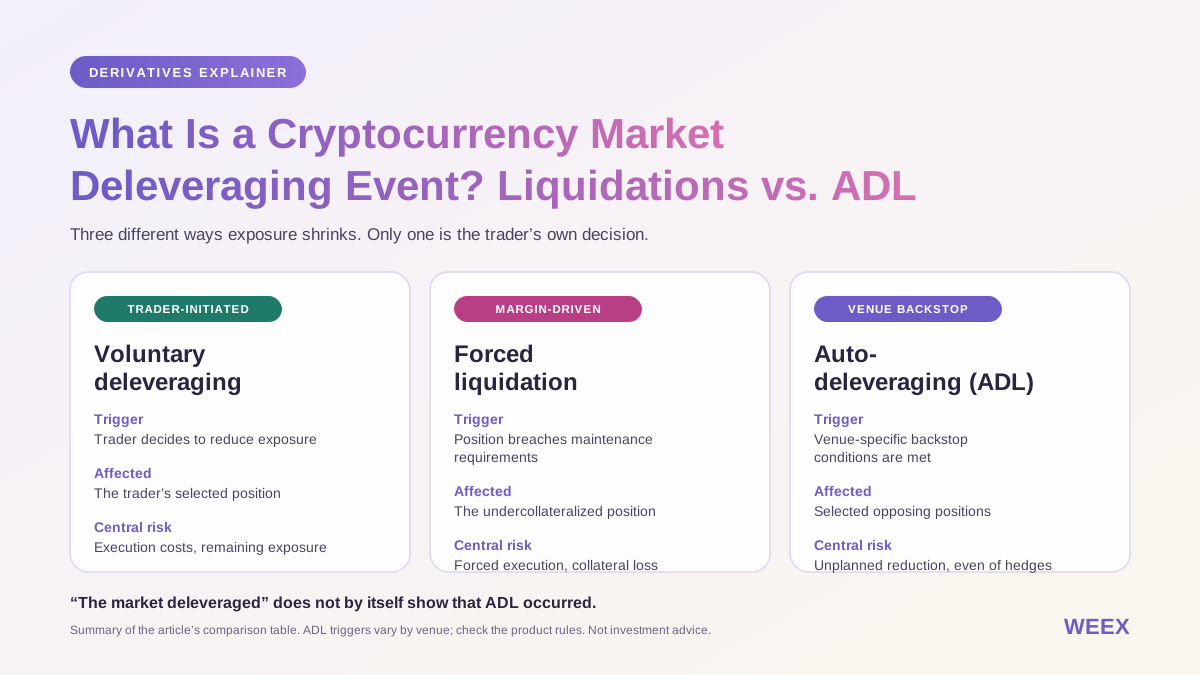
What Is a Cryptocurrency Market Deleveraging Event? Liquidations vs. ADL
Understand a cryptocurrency market deleveraging event: liquidation vs. ADL, misleading open-interest declines, hedge risks, and checks before trading.
Who Holds Tokenized Stocks? A Large Number of Retail Investors with Highly Concentrated Assets

Flash Loans Secure Two Governance Seats: What Does the X100 Theft Teach the Industry?

AI Reduces Vulnerability Discovery Costs, Crypto Industry Divided in Response

Real and Fake Cryptocurrency Market Makers: What Makes a Market Maker Legitimate?
Morpho RWA deposits pass $2B as loans approach $900 million
Key Institutional Prerequisite for Tokenization: Issuer Authorization
Kalshi Discusses User Protection Measures with Regulators, Willing to Raise Participation Age to 21
A New Wave of TGE? 19 Projects Expected to Launch Intensively in Q4
OCC Finalizes Stablecoin Issuance Guidelines in the U.S.
Reviewing the US, India, and South Korea: How Retail Investors Ignite the Options Market?





