
Aave reopens frozen markets but blocks new collateral loans

 Prefer us on Google


Emergency cap cuts at Aave preserve borrowing room to return to pre-Binance hot-wallet levels, even as LlamaRisk estimates they remove roughly $3.8 billion of unused capacity.
In an Oct. 30 update, risk service provider LlamaRisk said it had executed lower borrowing ceilings and temporary interest-rate changes on Aave V3 and V4. GHO borrow-cap cuts on the Core and Prime markets remained queued.
The measures follow an Oct. 29 emergency freeze, after LlamaRisk's initial assessment described the exploiter's Aave position as overcollateralized and subject to normal liquidation.
How much borrowing room remains
Aave V4's draw caps apply to individual credit lines through which a lending market, called a spoke, draws assets from a shared hub. While a reserve remains frozen, those ceilings cannot enable new borrowing.
LlamaRisk's cap methodology starts with the larger of borrowing before the exploit and borrowing at its observation time, then adds roughly 2%, with asset-specific rounded ceilings. It targets the larger borrowing paths with more than $10 million borrowed before the incident and more than $10 million of spare capacity.
That approach can sharply reduce an old ceiling while keeping it above earlier debt.
| Asset | Listed cap | Borrowing before exploit | Room above earlier borrowing |
|---|---|---|---|
| USDT | 2,560 million USDT | 2,504.7 million USDT | 55.3 million USDT |
| USDC | 2,270 million USDC | 2,215.9 million USDC | 54.1 million USDC |
Debt repayments can leave more room beneath the same ceiling. Core USDC's listed cap was approximately 248.4 million USDC above debt as of Oct. 30 because borrowing had fallen below its pre-exploit level.
Core WETH listed ceiling of 1.79 million WETH was above then-current debt of 1,749,730 WETH. LlamaRisk said current debt was the sizing basis because it included the exploiter's 19,762 WETH loan.
Separately, the queued GHO changes would cut Core's ceiling from 150 million to 105 million GHO and Prime's from 85 million to 35 million, a combined reduction of 95 million GHO.
Aave access depends on restored borrowing caps, lower rates, collateral eligibility and available pool liquidity.
Cash availability and borrowing costs
During the freeze, new supply and borrowing were blocked while withdrawals, repayments, and liquidations remained enabled. Users also could not supply extra collateral to frozen reserves.
Aave's withdrawal guidance limits exits to available, unborrowed liquidity. A supplier whose deposits secure a loan must also preserve the position's health.
At 00:26 UTC on Oct. 30, LlamaRisk put Core USDC utilization at 97.8%, with several other reserves displayed at 100%.
Reopening supply can allow cash to enter the relevant asset pool again, while repayments can return borrowed assets to it. Borrowing and supplier withdrawals consume that pool's available liquidity.
LlamaRisk also reported executing temporary Slope2 reductions. The recommendation lowers the steep part of Aave's borrowing-rate curve above its optimal utilization point. The proposed base rate, first slope, and optimal point stay unchanged, leaving modeled rates at or below that point unaffected.
A higher rate cannot attract fresh deposits into a reserve that rejects supply, while lower interest growth can ease pressure on borrowers without repaying their principal or supplying the cash needed for withdrawals.
Although LlamaRisk describes a universal 10% borrowing ceiling as the objective, its modeled full-utilization table lists 20% for Core DAI, 34% for Core USDtb, 25% for Monad mUSD and 19% for Ethereum Core frxUSD. Plasma GHO's proposed second slope is 5.25% in the summary and 11.5% in the specification.
LlamaRisk's later execution update does not identify which conflicting settings were deployed, so borrowers cannot use the broad 10% description as a confirmed ceiling for every affected reserve.
Collateral rules differ for new and existing positions
LlamaRisk's rollback plan describes four waves, with only the V4 collateral-configuration wave explicitly marked as already executed in the 13:49 UTC update.
For new borrowing, the plan keeps USDT, USDC, USDT0, POL, WAVAX, sAVAX, XAUt, PAXG and OP, including wrapped and bridged versions, at zero collateral borrowing power. On V3, the zero loan-to-value setting also applies in E-Mode, while the equivalent restriction is a zero collateral factor on V4.
Under the terms LlamaRisk describes, the same tokens can otherwise be supplied, withdrawn, borrowed and repaid once the relevant market restrictions are removed, subject to liquidity and normal account constraints.
On V3, liquidation thresholds remain unchanged, so the LTV reduction itself does not change existing health factors. On V4, a new borrow, collateral withdrawal, or collateral toggle moves an existing position onto the zero-factor configuration.
Aave's V3 Pool documentation adds another withdrawal condition: zero-LTV reserves must be disabled as collateral or fully withdrawn before withdrawing other assets.
Preserving earlier aggregate borrowing levels leaves room under the ceilings. Existing users still need the relevant market permissions and collateral configuration, while suppliers need enough unborrowed tokens for their exits.
Those conditions, together with the rate actually deployed on each reserve, determine what reopening delivers.
-- Price
This content is provided for general informational purposes only and doesn't constitute financial, investment, legal, or tax advice. Any events, rewards, online promotions, or related information mentioned herein should not be considered a recommendation, solicitation, or invitation to purchase, sell, trade, or otherwise deal in any crypto assets. Crypto assets are highly volatile and may result in loss. The availability of WEEX services, products, and related events may vary by region. You are responsible for ensuring that your participation is in accordance with applicable local laws and regulations.
You may also like

The Same Bad Debt: Five Points of Loss Recognition in DeFi Treasuries

LlamaRisk Proposes to Lower Borrowing Limits for Aave V3 and V4, Removing Approximately $3.8 Billion in Unused Quotas

Elon Musk Says AI Agents Could Engage in Crypto Theft

Mystery whale withdraws 290 million USDC from Aave, raises borrowing rates

Chainlink Launches 24/7 Price Service for Stocks

Chainlink Launches 24/7 Market Data Service to Support Tokenized Asset Trading
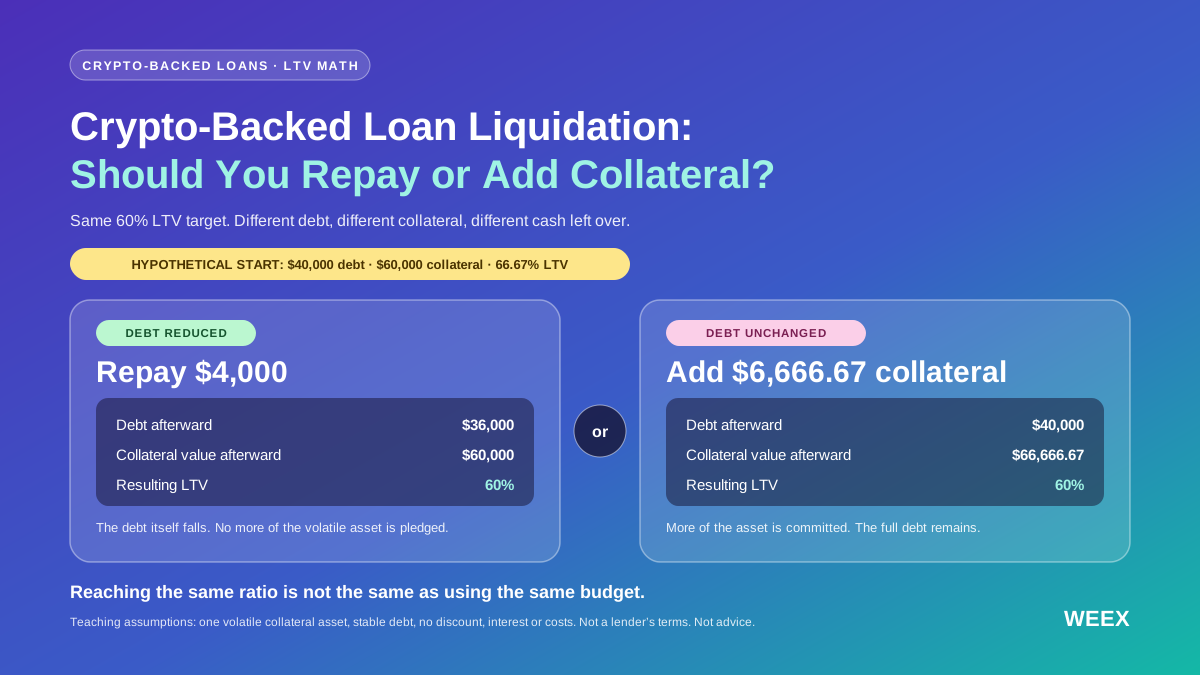
Crypto-Backed Loan Liquidation: Should You Repay or Add Collateral?
Facing crypto-backed loan liquidation? Compare repayment and collateral top-ups using equal budgets, LTV calculations, stress tests and protection limits.

3 payment rules control Aave’s native Bitcoin market, but only WBTC settles them

IOSG Ventures Invests in Funding Infrastructure Fun

Stablecoin Deposits in DeFi Grow to $24 Billion

Aave V3.8 Proposal Preserves Flash-Loan Liquidations

Aave Launches First Externally Curated V4 Markets with Sentora

Aave lowers USDT borrowing rate kink to 92% on Ethereum market

Sam Price Reveals Large Ethereum Transfer Dynamics

AI Spending Fears Hit Tech and BTC | WEEX Weekly Recap (2026.10.19-2026.10.23)
WEEX’s weekly recap covers AI spending, technology earnings, crypto assets, and oil. Tech stocks rebounded before selling off sharply: SpaceX results briefly lifted AI sentiment, while Meta, Tesla, and Lam Research drew mixed reactions. The Nasdaq then dropped, BTC retreated toward $81,000–$82,000, oil climbed, and gold and silver weakened.

WEEX Exclusive:AI Spending Fears Hit Tech and BTC | WEEX Weekly Recap (2026.10.19-2026.10.23)

Aave Founder Announces Aavenomics 3.0 Includes AAVE Buyback, Staking, and Burn

Crypto rallies point to slower USDC growth and faster USDT growth, study finds
SpaceX’s $194 billion share unlock exposes a major risk in Aave’s tokenized stock ambitions

Who is Driving the Rapid Growth of Stablecoins?
Citi Research Evaluates Aave as Core Infrastructure for Tokenized Asset Finance

Citigroup Research Positions Aave as a Decentralized Collateral Liquidity Protocol
Citrini Research Sees Opportunities in Tokenization Beyond Bitcoin and Ethereum

Aave Adoption vs AAVE Value: What Arc’s $100M Milestone Reveals
Explore Aave V4’s $100M Arc lending milestone, how protocol growth connects to AAVE value, and the revenue, buyback and market risks to watch.
Aave Advances Native Bitcoin Collateral Proposal

Citrini Releases Report Bullish on RWA Tokenization, Focuses on Profit Attribution

Tokenized Asset Coalition Launches DeFi Composability Framework for Tokenized Securities GAP

Native Bitcoin collateral on Aave triggers WBTC pool deficit
Superform Reveals Tokenized Stock Revenue Structure

Grayscale Partners with Republic to Offer DeFi and Decentralized AI Investment Products
The Same Bad Debt: Five Points of Loss Recognition in DeFi Treasuries
LlamaRisk Proposes to Lower Borrowing Limits for Aave V3 and V4, Removing Approximately $3.8 Billion in Unused Quotas
Elon Musk Says AI Agents Could Engage in Crypto Theft
Mystery whale withdraws 290 million USDC from Aave, raises borrowing rates
Chainlink Launches 24/7 Price Service for Stocks
Chainlink Launches 24/7 Market Data Service to Support Tokenized Asset Trading
Contents
Latest articles


Latest coin listings on WEEX


