
The Same Bad Debt: Five Points of Loss Recognition in DeFi Treasuries

 Prefer us on Google


From Morpho to Aave: Bad debts are not scary; the timing of loss recognition determines who pays the bill.
Written by: @definikos
Compiled by: AididiaoJP, Foresight News
The treasury loss routing diagram does not answer "Will there be a loss?" It only addresses what happens after a loss: when the loss is recognized on the books, which balance it first falls on, what absorption layers exist in between, what depositors ultimately see, and who cannot escape.
Each strategy's sub-account should fill out this table before the first deposit.
The Same Bad Debt, Five Points of Loss Recognition
Assuming there is a $3 million bad debt corresponding to $100 million in deposits.
In Morpho's isolated market, the moment the last batch of collateral is liquidated, all depositors immediately bear a 3% loss.
In Aave's shared liquidity pool, the depositors' aToken balance remains unchanged on the books. The bad debt is written off, and the pool records a deficit, with the buffer collateral in Umbrella being reduced. The remaining gap after coverage is borne by depositors as residual insolvency, rather than being directly deducted from the deposit balance. Note: Umbrella is Aave's bad debt buffer mechanism: users stake assets to earn rewards, at the cost of their corresponding stake being reduced to cover gaps when bad debts occur.
In the Morpho Vault V1.1 curation treasury, the share price remains completely unchanged, and the last depositor to leave leaves the loss to those who remain.
Queue-based treasuries price based on valuation reports submitted periodically by oracles. Nothing changes on the books until the next valuation comes out. If this valuation drops beyond a preset suspicious range, the report will be isolated, and the treasury will be frozen directly.
In a tiered structure with a 10% junior layer, the entire $3 million bad debt falls on the $10 million junior layer, which incurs a 30% loss, while the senior layer remains unaffected.
The amount of loss is the same each time. What changes is the path the loss takes and when it is recognized. When the loss is recognized and which layer it falls on determines who ultimately pays the bill.
As long as a loss has occurred but has not yet been booked, those who can exit at the old price will shift their share of the loss onto those who remain.
Five Questions for Each Structure
This diagram asks the same five questions for each structure:
Trigger: What event confirms the loss on the books?
It is not enough for "the asset has actually lost value"; a blockchain event must write the loss into the accounting. Liquidation of bad debts, valuation reports, impairments, and governance votes can all serve as triggers. If the trigger does not occur, the loss remains off the books.
First Fall: Which balance does the loss first fall on?
After the loss is confirmed, which number changes first? It could be the total deposits in the market, the deficit in the liquidity pool, the share price of the treasury, or a junior layer. Different first fall points lead to completely different responsibilities for who bears the loss later.
Absorption Layer: What stands between the first fall point and the depositors?
Losses do not necessarily fall directly on depositors. There may be deductions, forfeitable stakes, junior layers, or first-loss layers in between. The thicker these layers are, the smaller the loss depositors see; once these layers are exhausted, it is the depositors' turn.
Reach: What do depositors actually see?
The book performance and the real loss may not be the same. Depositors may see a drop in share prices, a frozen redemption queue, or the books still showing face value, but the underlying claims have already been impaired.
Loss Recognition Timing: When does this loss count?
Is it recognized immediately in the same block, or does it wait for the next interaction, the next report, a governance vote, or even never? The later the loss is recognized, the more people have the opportunity to exit at the old price, leaving the loss to those who remain.
As long as the oracle continues to quote collateral at face value, the system will not see that the collateral has depreciated, and liquidation of bad debts will not trigger. Losses will not be booked and will remain off the books until someone forcibly pushes for liquidation or updates the price.
Lending Market: Where Does the Loss First Fall?
Isolated Market
In Morpho's isolated market, after the liquidator takes the last batch of collateral from the borrower, if the debt is not fully repaid, the remaining portion will be written off in the same call, borne proportionally by all depositors in that market.
The bad debt formula can be written as:
BD = D − C·p / LIF
Where D is the debt, C·p is the value of the collateral, and LIF is the liquidation incentive.
For example: $10 million in debt, collateral price drops to $7.3 million, LIF is 1.044, LLTV is 86%:
10 − 7.3 / 1.044 ≈ $3 million, which is 3% of the $100 million market.
There are no reserves or funds in between the bad debt and the depositors; the loss will directly fall on the depositors in this market. In theory, the loss recognition timing is the same block in which the liquidation occurs. However, this requires three conditions to be met:
- First, the oracle must determine that this position is under-collateralized and in an unhealthy state;
- Second, the liquidator must believe that the last bit of collateral is still worth taking, not losing after deducting the liquidation reward;
- Third, the oracle call must not error.
If any of the three conditions is missing, this loss will not be confirmed at that moment and may remain off the books, becoming "never recognized."
Shared Liquidity Pool
Since Aave v3.3, if the collateral in an account goes to zero after liquidation and there is still remaining debt, the remaining debt will be burned, and a deficit will be recorded on the reserves.
This deficit is accounted for separately and does not directly change the exchange rate of aTokens. Therefore, when depositors open their accounts, the balance they see remains at its original face value and does not immediately decrease.
Next, Umbrella will fill this hole, in the order: first using the pre-allocated deficit deduction from the DAO, which acts as the first layer of buffer; if that is exhausted and still not enough, UmbrellaCore will automatically reduce the aTokens staked by users in that asset pool to fill the remaining gap.
Note that even if the staker has applied to exit and is in a 20-day cooling-off period waiting for unlocking, this staked portion may still be reduced. The cooling-off period does not equal a safety period.
What remains after two layers is the residual insolvency, which can only be injected by governance.
Each depositor's uncovered gap can be written as:
h = max(0, B − O − Z) / S
Where B is the bad debt, O is the deduction, Z is the forfeitable stake, and S is the total deposits.
For example: $5 million in bad debt, $100,000 in deductions, $3 million in stakes, $500 million in deposits:
(5 − 0.1 − 3) / 500 = 0.38%.
0.38% is just the calculated average gap; no one will have 0.38% directly deducted from their account. As long as there is still money in the pool, withdrawals will still be paid out at a 1:1 ratio, and those who leave first will get back at face value. The hole will not disappear; it will just be left for those who have not yet left. Whoever holds the deposit position last will bear all uncovered losses.
-- Price
Treasury Accounting: The Same Bad Debt, Different Loss Recognition Timing
The curation treasury is built on top of the isolated market. The market is responsible for confirming losses, while the treasury version determines when the share price sees the loss.
Vault V1.0: Losses are recognized immediately, and everyone shares the burden proportionally.
Once a bad debt liquidation occurs, the share price is immediately cut. For example, if a $100 million treasury loses $4 million, the share price immediately drops by 4%. All current holders bear the burden proportionally, regardless of whether they have left or not.
Vault V1.1: Losses are recorded but do not change the price; the last to leave bears the burden.
When a bad debt occurs, the loss is recorded in the lostAssets account, but the share price remains unchanged. Those who withdraw first still take their money at the old price, effectively exiting at face value. The hole remains in the treasury, and those who have not left yet bear the burden. Unless the curator themselves covers this gap with their own money.
Vault V2: Losses are recognized only when the next interest period reveals that actual assets are lower than book assets.
V2 does not book losses at the moment of bad debt liquidation but waits until the next interest period. At that time, the system compares the actual assets of the adapter with the total book assets recorded by the treasury: if the actual assets are already lower than the book total, the difference is recorded as a loss.
Deferral turns losses into a queue. Assuming a deferral of X, treasury assets A, and W withdrawn before confirmation, the loss borne by those who remain is:
h = X / (A − W)
For example: if a $100 million treasury loses $4 million and $60 million is withdrawn first:
4 / 40 = 10%, whereas if booked immediately, it would only be 4%.
V2 also has its own version. Before the market confirms the bad debt, the bad debt loan continues to accrue interest, raising the share price. New depositors come in at this price, and early leavers take interest without corresponding assets. Setting maxRate to 0 can stop further interest accrual, but what has already been accrued cannot be retrieved.
Treasuries with Redemption Queues: Losses Recognized Only at Valuation Reports
In treasury structures with strategy permission controls, no venue will directly write losses into the share price. Losses must wait until the next report to take effect: the submitting party lowers the position price item by item. Then, safety parameters determine how to route.
- If the fluctuation falls within the suspicious range, it is accepted as normal.
- If it falls between the suspicious range and the maximum deviation, the report is isolated, and deposits, redemptions, and fees are all frozen until an independent reviewer signs off.
- If it exceeds the maximum deviation, it rolls back directly.
Any redemption batches priced according to reports that have not yet included the loss will still be paid at the old price.
Nested Treasuries: Losses Must Be Recognized Twice
The parent treasury invests money into the child treasury, which then invests in underlying assets. After the child treasury incurs losses, it must first recognize them at the child treasury level; the parent treasury will wait until its next interest period or report to pass the losses up. This means the same loss must be recognized twice, with a time lag in between.
During this time, the share price of the parent treasury still displays the old price. Those who can exit at the old price leave the loss to those who remain.
Converted to the parent treasury level, the loss is the weight of the parent treasury's investment in the child treasury multiplied by the child treasury's loss. For example, if the parent treasury has 20% of its assets invested in the child treasury and the child treasury loses 10%, the loss at the parent treasury level is 2%.
You Write the Absorption Layer into the Structure
Tiered Structure
When there is a junior layer J, the loss is distributed as follows:
L_J = min(Loss, J), L_S = max(0, Loss − J)
Pool 100, junior 10, loss 15: junior is fully wiped out, senior bears the remaining 5; senior principal 90, loss about 5.6%.
But the triggering rights are usually not in your hands. Neutrl paused NUSD minting and redemption on August 13, and reopened on September 17 with a redemption rate of 0.51. On Strata, about one-fifth of the structure's jrNUSD was wiped out, and srNUSD bore the remainder. During the pause, the tracking price of NUSD remained around 0.998, so before the issuer provided a new price, the waterfall for loss distribution could not start.
First Loss Stake
The initiator's stake only becomes a junior layer when someone actually burns it; otherwise, it incurs losses proportionally with other shares.
For example: a $200 million treasury, with cyclical sub-accounts occupying 10% of NAV and 4x leverage, collateral discounted by 10%:
10% × 4 × 10% × $200 million = $8 million loss.
If $3 million of stake is burned:
(8 − 3) / 197 ≈ 2.5%, borne by depositors.
If the burning of the stake is later than the write-down of a report, then those in between, priced at the old price, bear the loss first, while burning the stake compensates those who remain.
Losses Decided by Others
Cyclical sub-accounts
Leveraged sub-accounts will first amplify losses and then route them. The approximate relationship is:
ΔE/E ≈ L·w
With 4x leverage and a 10% collateral discount, the sub-account equity directly incurs a 40% loss, plus liquidation rewards and unwinding slippage. The treasury will not see this until the next report.
Collateral Issuers
Cross-chain LRT, synthetic dollars, RWA funds; how much loss is incurred is often decided by issuers, managers, or votes, often weeks after the event itself.
When cross-chain bridges mint unbacked tokens, the issuer decides whether the entire holder group shares the gap or whether a specific chain's wrapped assets bear it alone. Aave's rsETH event report calculated the unified sharing scenario:
112,204 / (629,689 + 112,204) ≈ 15.1%.
Synthetic dollars rely on reserve funds to absorb two types of losses: negative funding fees and gaps when underlying collateral is insufficient to support liabilities. However, reserve funds are not infinite; documents usually state they are used to cover losses but do not specify what happens when they are exhausted.
Neutrl's actual answer was to lower the redemption rate. NUSD paused minting and redemption on August 13 and reopened on September 17 with a redemption rate set at 0.51. This means that 1 NUSD is no longer redeemable at 1 dollar but can only be redeemed for 0.51 dollars. The portion that the reserve fund cannot cover is transferred to holders in one go through the redemption rate.
This indicates that the "1 dollar" of synthetic dollars is not a guarantee but a target. When the reserve fund is thick, the peg appears stable; when the reserve fund is exhausted, how losses are distributed depends on how the issuer sets the redemption rate. The document not stating it does not mean the risk does not exist; it just means the rules are decided by the issuer on the spot.
Private Credit
The path of private credit is the opposite. On Maple, lenders who withdraw during impairment turn the impaired value into permanent losses; any subsequent recoveries are proportionally distributed to the remaining lenders.
$1 million, 10% impairment; those who leave take $900,000. If the borrower later repays, those who remain recover to $1 million, while those who left lock in the loss.
Here, early leavers lock in losses, while those who remain can receive recovery funds.
Loss Routing Map
Conclusion
The same bad debt, where it falls on which balance, how many layers of buffer are in between, whether depositors see a drop in share price or the books remain unchanged, and when the loss is recognized, determines who ultimately pays the bill.
Before the first deposit, each strategy sub-account should clarify the five questions: what event triggers the loss, where the loss first hits, what absorption layers are in between, what depositors actually see, and when this loss is recognized.
If the five questions are not clearly filled out, you may think you are buying returns, but in reality, you are buying a queue position left by others who exited at the old price.
This content is provided for general informational purposes only and doesn't constitute financial, investment, legal, or tax advice. Any events, rewards, online promotions, or related information mentioned herein should not be considered a recommendation, solicitation, or invitation to purchase, sell, trade, or otherwise deal in any crypto assets. Crypto assets are highly volatile and may result in loss. The availability of WEEX services, products, and related events may vary by region. You are responsible for ensuring that your participation is in accordance with applicable local laws and regulations.
You may also like

Spark's Q3 Lending Market Share Rises to 13.2%, Net Income Drops 30%

1kx Blockchain Industry In-Depth Report: Who is Really Making Money?

USDD Reports Strong Treasury Performance, Growth in Key Metrics, and Ecosystem Expansion

Morpho RWA deposits pass $2B as loans approach $900 million

Birch Hill Completes $4 Million Seed Round Financing Led by Multicoin Capital

A New Wave of TGE? 19 Projects Expected to Launch Intensively in Q4
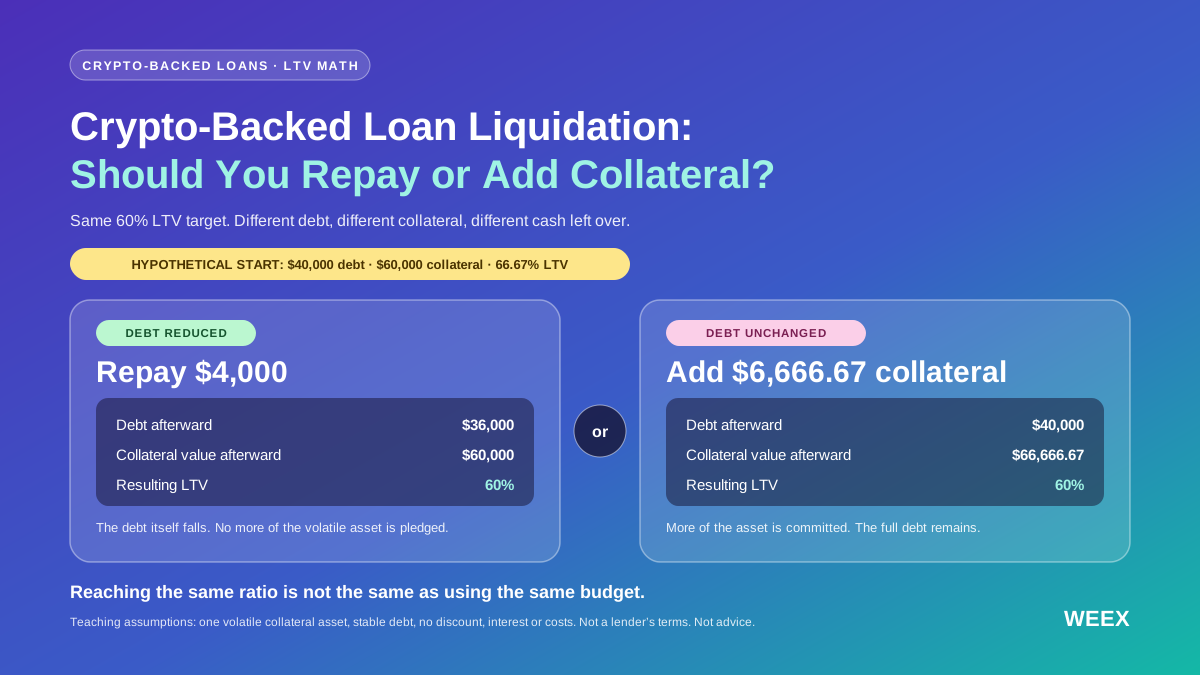
Crypto-Backed Loan Liquidation: Should You Repay or Add Collateral?
Facing crypto-backed loan liquidation? Compare repayment and collateral top-ups using equal budgets, LTV calculations, stress tests and protection limits.

Who Holds Tokenized Stocks? A Large Number of Retail Investors with Highly Concentrated Assets

Stablecoin Deposits in DeFi Grow to $24 Billion

Five DeFi Projects Under Observation: From Tiered Vaults to On-Chain Perpetual Order Books

[Column] Robinhood Chain: The Meme Coin Craze May Be Over, But Growth Continues

Weekly Highlights | Gold Drops Below $4000 During Golden Week, a16z Crypto Renamed to a16z Frontier

Lido Introduces Turbulence Controls Mechanism to Address Extreme Events

$1.2 Billion in Trading Volume Over 5 Days, TVL Only $11 Million: Why Metric is Worth Watching?

Robinhood Stock Tokens Access Morpho Lending Market

DeFi Gold Mining Guide: 5 Potential Projects to Watch

Ledger Wallet Launches Crypto Lending Feature, Supporting cbBTC and wBTC Collateral to Borrow USDC and USDT

Morpho P2P Order Functionality Supports Any Lending Asset
Lido’s proposed exits would pay lenders with borrower collateral

Five DeFi Projects Under Observation: From Tiered Vaults to On-Chain Perpetual Order Books

Institution Loses 973,000 MORPHO in Theft Worth Approximately $2.3 Million
DefiLlama and Trueo Launch Protocol Revenue and Vulnerability Probability Market

$800 Million Raised in Three Weeks, Yet 80% of Funds Are 'Lying Flat': How Much Real Demand Is There in the 'Giant Game' of OUSD?

Can UNI's Valuation Premium Hold Up After the Fee Switch Goes Live?

Bitcoin Holders Reach Record Lending Volume on Base

What Makes Spending on AI Agents Difficult?

Decline in Trading Activity for Robinhood Chain Meme Coins, On-chain Funds Flowing to Stablecoin Lending

Lido Introduces Fallback Exits Mechanism to Support Lenders in Withdrawing Collateral
Crypto wallets expand into DeFi hubs as swaps and yield move in-app
From Institutional Settlement to Open Ecosystem: Can Canton Replicate the Development Path of Robinhood Chain?
Spark's Q3 Lending Market Share Rises to 13.2%, Net Income Drops 30%
1kx Blockchain Industry In-Depth Report: Who is Really Making Money?
USDD Reports Strong Treasury Performance, Growth in Key Metrics, and Ecosystem Expansion
Morpho RWA deposits pass $2B as loans approach $900 million
Birch Hill Completes $4 Million Seed Round Financing Led by Multicoin Capital
A New Wave of TGE? 19 Projects Expected to Launch Intensively in Q4


