
Should You Buy AVGO Stock? What a Street Wide "Strong Buy" Rating Actually Requires

 Prefer us on Google
Almost every analyst covering Broadcom agrees on the same thing right now: buy AVGO stock. A "Strong Buy" consensus this uniform is rare, and AVGO stock currently carries one of the more lopsided rating distributions in large cap tech. But a consensus rating isn't a guarantee, and understanding what has to actually happen for AVGO stock's rating to hold up is a different exercise than simply counting how many analysts agree with it.
This isn't a question of whether Broadcom is a good company. The business results speak for themselves. The real question is narrower and more specific: does the current price already reflect everything that consensus optimism is betting on, or is there still room for the stock to move if Broadcom keeps executing at its current pace.
What A "Strong Buy" Rating Actually Represents
A "Strong Buy" consensus is an aggregation, not a single judgment. It reflects dozens of individual analysts, each running their own models, arriving independently at similar conclusions. According to StockAnalysis.com, roughly 49 analysts currently rate AVGO stock, with the average leaning toward "Strong Buy" and a 12 month price target implying meaningful upside from recent trading levels.
What that consensus doesn't tell you is how much of that optimism is already priced in. A stock can carry a unanimous bullish rating and still underperform if the price has already run ahead of what even optimistic analysts expect, because a rating reflects direction, not timing, and it says nothing about how much patience a position requires before the thesis plays out.

The Valuation Math Behind The Optimism
Broadcom trades at a price to earnings ratio in the low 60s, a multiple that only makes sense if the market believes current growth rates are durable rather than a temporary spike tied to one AI buildout cycle. A P/E this elevated isn't unusual for a company growing revenue at the pace Broadcom has posted recently, but it does raise the bar for what "good enough" actually means going forward.
This is where the Strong Buy rating gets tested in practice. Broadcom's fiscal 2025 revenue grew nearly 24% year over year, with earnings climbing even faster, according to company results compiled by StockAnalysis.com. A P/E in the 60s prices in continued growth at something close to that pace, not merely growth that stays positive. If Broadcom's expansion decelerates meaningfully from here, even while remaining solidly profitable, the current multiple becomes harder to justify, and a stock trading on a rich multiple has less room to absorb disappointing news than one trading on a conservative one.
What Would Actually Need To Be True For The Rating To Hold
Rather than treating the Strong Buy consensus as a conclusion, it's more useful to lay out what specifically needs to happen for that rating to be justified rather than simply hoped for. AI-related semiconductor demand needs to keep expanding at a pace close to what Broadcom has already demonstrated, since that segment has become the primary engine behind the company's overall growth. A slowdown concentrated in this specific segment would matter more to the stock than weakness anywhere else in the business, given how much of recent growth has come from AI-driven chip demand specifically.
Broadcom's own forward guidance also needs to hold up against reality in the quarters ahead. Management has already raised its full-year AI revenue outlook once this year, moving from an earlier figure toward a higher one, according to StockAnalysis.com's coverage of recent guidance updates. A company that keeps raising its own targets and then hitting them builds credibility that supports a premium valuation. A company that raises targets and then falls short erodes that same credibility quickly, and the market tends to punish a broken guidance track record more severely than it rewards a maintained one.
Diversification beyond the AI narrative matters here too. Broadcom's Infrastructure Software segment, while growing more slowly than its semiconductor business, provides a source of revenue that isn't as tightly correlated to AI capital expenditure cycles. A Strong Buy rating built almost entirely on one high-growth segment carries more concentration risk than one supported by multiple, less-correlated revenue streams, and how much weight investors put on that software segment's steadier growth is likely to matter more during any period when AI-specific spending shows signs of moderating.
-- Price
Why The Rating Doesn't Answer The Timing Question
None of this settles when to buy, only what to watch for. A stock can have every fundamental reason to go higher over a multi-year horizon while still delivering a rough six months if it entered that period trading above what near-term results can support. Broadcom's stock has already moved significantly over the past year, and the distance between its current price and its 52-week high versus its 52-week low says something about how much of the good news has already been absorbed into the price at any given moment.
This is where the Strong Buy rating and an individual investor's actual time horizon can diverge sharply. A rating built around a 12 month price target is making a statement about where analysts expect the stock in a year, not about what happens in the interim, and a position that's fundamentally sound over that longer window can still produce a volatile, uncomfortable ride getting there.

Which Investor Profile The Current Setup Actually Suits
Rather than a single answer, the more useful framing is which kind of investor is actually positioned to benefit from buying AVGO stock at current levels. An investor with a multi-year horizon who believes AI infrastructure spending has structural staying power, rather than representing a temporary capital expenditure cycle that eventually normalizes, is underwriting a thesis that the Strong Buy consensus is fundamentally aligned with, and short-term volatility around any single quarter matters less to that investor than the multi-year growth trajectory does.
A shorter-term trader looking to time an entry around a specific catalyst faces a different calculation entirely. For that investor, the Strong Buy rating itself provides little edge, since it's already public information fully reflected in how the stock trades. What matters more is whether the next few data points, guidance execution, AI capex commentary from Broadcom's own customers, and how the broader semiconductor sector trades around upcoming earnings from peers, confirm or challenge the assumptions the current rating depends on.
For traders looking to act on volatility like this, WEEX offers stock trading covering major global markets, alongside futures products backed by a publicly disclosed 1,000 BTC protection fund, giving traders a verifiable layer of security when navigating volatile markets.
Conclusion
A Strong Buy consensus from nearly 50 analysts reflects genuine confidence in Broadcom's fundamentals, but it isn't a substitute for understanding what that confidence actually depends on. The rating holds up if AI-driven semiconductor demand keeps expanding at something close to its current pace, if management's guidance continues to prove accurate rather than optimistic, and if the company's software business provides enough diversification to cushion any slowdown concentrated in AI-specific spending. Whether AVGO stock is a buy at any given moment depends less on the rating itself and more on an individual investor's time horizon and tolerance for volatility along the way.
FAQ
1. What does a "Strong Buy" consensus rating on AVGO stock actually mean?
It reflects the aggregated views of roughly 49 individual analysts, most leaning bullish, but it's a directional judgment about the stock's longer-term trajectory rather than a guarantee or a statement about near-term timing.
2. Is AVGO stock's valuation justified by its current growth rate?
The stock trades at a price to earnings ratio in the low 60s, a multiple that requires continued strong growth to sustain. If growth decelerates meaningfully, that valuation becomes harder to justify even if the company remains profitable.
3. What would need to happen for AVGO's Strong Buy rating to hold up?
AI-related semiconductor demand would need to keep expanding near its current pace, management's forward guidance would need to keep proving accurate, and the company's software segment would need to keep providing diversification beyond the AI-driven growth story.
4. Does a bullish analyst rating mean now is the right time to buy?
Not necessarily. A rating reflects a directional view over a longer horizon and doesn't account for whether a stock has already priced in near-term good news, which affects timing more than a rating alone can capture.
5. Who is AVGO stock's current setup best suited for?
Investors with a multi-year horizon who believe AI infrastructure spending has structural staying power are more aligned with the current Strong Buy thesis than shorter-term traders looking to time a specific entry point.
This content is provided for general informational purposes only and doesn't constitute financial, investment, legal, or tax advice. Any events, rewards, online promotions, or related information mentioned herein should not be considered a recommendation, solicitation, or invitation to purchase, sell, trade, or otherwise deal in any crypto assets. Crypto assets are highly volatile and may result in loss. The availability of WEEX services, products, and related events may vary by region. You are responsible for ensuring that your participation is in accordance with applicable local laws and regulations.
You may also like

Broadcom Stock Price Fell After 86% Revenue Growth: What the Q4 Guidance Gap Actually Means

What Is Tangem Wallet? A Complete Beginner's Guide

MetaMask Transaction Stuck or Failed? Here's How to Fix It

John Ternus Is Apple's New CEO: What He Inherits After 15 Years of Tim Cook

Meta Stock Rallied After a $16.68 Billion Settlement: Why a Legal Loss Sent Shares Higher

Easypaisa P2P Payments: How to Choose a Merchant and Confirm a USDT Order
XST Stock: Why This Ticker Points to Four Completely Different Companies

AAPL Under Ternus: What Apple's CEO Change Means for Traders
CyberLeek Crypto: The GTA 6 Token's Exit Liquidity Problem

AIINU After LongX: What the NVDA 3x Fee Loop Actually Pays
MetaMask Seed Phrase & Private Key Security Guide
How to Install and Set Up MetaMask (2026 Updated Guide)
What Is MetaMask? A Complete Beginner's Guide
What Is Arbitrum (ARB) and How Does This Ethereum Layer 2 Work?
Is Arbitrum (ARB) Worth Buying After Its 30% Rally? An Analysis About Utility, Supply and Risks

GoPro Stock Soared 40%: What the $1.14 Merger Actually Pays

Stealth XST Coin: The $1,806 Daily Volume Behind a $2.3M Cap
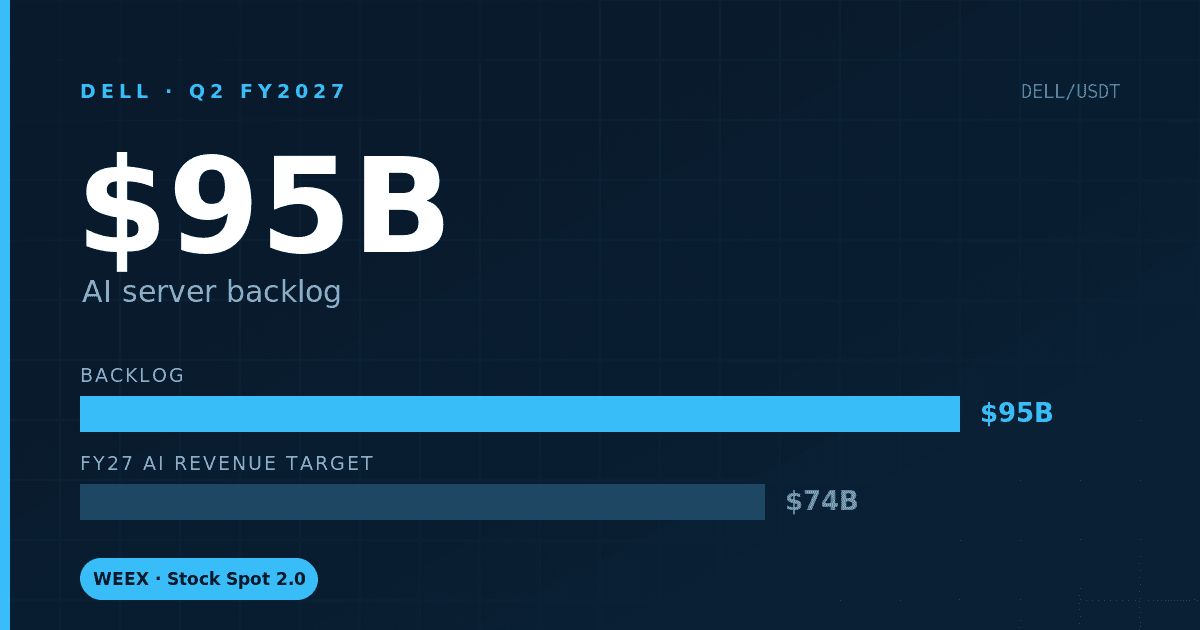
Dell Earnings: $95B AI Backlog Now Dwarfs Its Own Guidance

Fable 5.1: What Anthropic's New Model Means for AI Tokens

Dell Stock Surges 9.4% After Smashing Earnings Estimates: What Drove the AI Server Beat

Why Is GoPro Stock Surging 80%? A YouTuber's 8.5% Stake and a Short Squeeze Collide

XST ETF vs XST Coin (XSolut): Don't Confuse These Two Completely Different Assets
What Is PONS? Inside the "100x Coin" Taking Over Robinhood Chain
Stock Spot vs Perpetuals vs Real Stocks: Key Differences
WEEX Stock Spot 2.0 Rewards Guide: Trade & Share $100K
ARK Invest Crypto Stocks vs ARKB: How Cathie Wood Gets Crypto Exposure
Which ARK ETFs Hold Coinbase Stock? COIN Exposure in ARKK, ARKW and ARKF
How Much Coinbase Stock Does Cathie Wood Own? ARK’s COIN Position Explained

Why Is Cathie Wood’s ARK Invest Buying Coinbase, Circle, BitMine and Bullish?
Cathie Wood’s $50 Million Crypto Stock Bet Explained: What Did ARK Invest Buy?
Broadcom Stock Price Fell After 86% Revenue Growth: What the Q4 Guidance Gap Actually Means
What Is Tangem Wallet? A Complete Beginner's Guide
MetaMask Transaction Stuck or Failed? Here's How to Fix It
John Ternus Is Apple's New CEO: What He Inherits After 15 Years of Tim Cook
Meta Stock Rallied After a $16.68 Billion Settlement: Why a Legal Loss Sent Shares Higher
Easypaisa P2P Payments: How to Choose a Merchant and Confirm a USDT Order
Contents
Popular coins
Latest articles


