
AIINU After LongX: What the NVDA 3x Fee Loop Actually Pays

 Prefer us on Google

AIINU gained a genuinely new mechanism on 1 September 2026 — and it is smaller than the headlines suggest. Long.xyz launched LongX Expansion, wrapping 3x leveraged NVIDIA positions held on Lighter into a freely mintable ERC-20, with fees from that activity routed back to AI, the token WEEX lists as AIINU. The narrative is strong: AI compute, tokenized equities, and leverage stacked on one Robinhood Chain asset. The arithmetic is more sober. As of 3 September 2026, AIINU trades at $0.284227 with a market cap of $268.902 million on 1.000 billion circulating tokens, while the community vault the fee loop feeds has accumulated roughly $190,000 in NVDA — about 0.07% of that cap. This piece breaks down how the LongX mechanism is plumbed, what the vault has actually captured, and the leverage math that the meme layer obscures.
What LongX Expansion actually changed for AIINU
Long.xyz launched its first LongX product, NVDA 3x Long (NVDAx3L), on 1 September alongside a demo trading pair, DEMOTHREE/NVDAx3L. Foresight News reported DEMOTHREE's market cap peaked near $6 million on roughly $3.2 million of volume that day, while AI itself peaked around $213 million.
The structural change is what a meme token can now be quoted against. AIINU's original innovation was pairing against tokenized NVDA rather than WETH, which is the story WEEX covered in its AIINU origin explainer. LongX extends the collateral menu from spot equity exposure to leveraged equity exposure. A memecoin can, in principle, now be priced against a 3x NVDA position.

Long has been unusually direct about the maturity level here: the company called the expansion "highly experimental," and only the official demo pair is protected. Any self-launched NVDAx3L pair is not.
Worth noting for anyone reading "first mover" into this: it isn't. RobinVista shipped a 2x wrapper, NVDA2L, on 24 July 2026 — it simply lacked a paired meme issuance mechanism, which is the part that generates fees.
How the NVDAx3L wrapper works, and where its NAV lags
NVDAx3L is issued by a LongX vault contract with open minting. Anyone deposits, receives shares struck at the net asset value at that moment, and the protocol holds and rebalances the underlying 3x position on Lighter — the zk-rollup perpetuals venue that raised $68 million at a $1.5 billion valuation in November 2025 with Robinhood Markets among its backers.
The mechanic that matters for traders is settlement timing. NAV is computed after Lighter submits state proofs to Robinhood Chain in batches. The primary market — minting and redemption — clears at NAV. The secondary market — the DEX pool — clears continuously at whatever price flow dictates. Those two paths can diverge, and the design assumes arbitrageurs close the gap.
In practice, that assumption is where the money is made and lost. Arbitrage requires someone to carry inventory across the proof interval, wearing NVDA's movement at 3x while the reference NAV is stale. In a calm tape, the spread is thin and the mechanism looks clean. In a fast NVDA move, the arbitrage stops being riskless, spreads widen, and the pool price is the one you actually transact at — not the NAV on the dashboard.
Does the fee flywheel actually reach AIINU holders?
This is the claim every write-up repeats and none quantify. Here is the actual plumbing.
Fees come from Uniswap V4 hook settings on Long's pools — not from a buy/sell tax written into the token contract, which is a meaningfully better design because it doesn't break composability. When an issuer enables Community Mode, the fee recipient switches from a personal wallet to the official vault, and the split runs:
- Buy side, where fees accrue in the stock token: 80% to the vault, 20% to the original recipient. Only the protocol can change these parameters.
- Sell side, where fees accrue in the meme token itself: half burned permanently, half locked into the vault.
Now the numbers, as reported on 1 September 2026. The AI Community Vault held approximately $190,000 of NVDA tokens. Approximately 8.4 million AI had been permanently burned, with another 8.4 million locked in the vault.
Run that against supply and cap. The burn is 0.84% of the 1.000 billion circulating supply; burn plus lock is 1.68%. The NVDA in the vault, against a $268.902 million market cap, is roughly 0.07%. Separately, more than 9,000 NVDA shares sit locked in the Uniswap pool — around 17% of Robinhood's tokenized NVDA circulating supply, which is a real liquidity fact but belongs to the pool, not to token holders.
The better reading is that this flywheel is currently a signalling mechanism, not a valuation floor. It demonstrates that fees are being captured somewhere other than a founder's wallet, and 1.68% of supply removed or immobilised in roughly a month is not nothing. But vault assets are static today. Long's roadmap lists buybacks, pool additions and airdrops as future uses, and as of 1 September there was no verifiable public contract code for those functions. Until the vault can deploy, the accumulated NVDA is a number on a page, not a bid.
-- Price
The 3x decay problem nobody prices into a meme pair
Leveraged wrappers have a well-documented cost that is arithmetic, not fees. A rebalanced 3x position must buy into strength and sell into weakness to maintain its multiple, which makes the outcome path-dependent: a round trip that leaves the underlying flat leaves the leveraged wrapper down. WEEX's breakdown of why the 3x inverse Nasdaq ETF bleeds value puts hard numbers on the traditional version — 99.97% lost since inception, from a product that tracked its daily objective correctly every single day.
NVDAx3L is not structurally identical to a daily-reset ETP. It is a perpetuals position rebalanced by protocol, so it also carries funding costs and liquidation exposure that an ETP wrapper does not. But the path-dependency logic transfers, and NVDA's realised volatility is high enough that it bites. Three things stack when a memecoin is quoted against this wrapper:
- NVDA's own move, amplified threefold.
- Rebalancing drag plus perp funding on the wrapper.
- The meme token's independent, sentiment-driven repricing.
That third layer has historically dominated. Between July and 1 September, NVDA moved from $208.76 to roughly $220.78 — about 6% — while AI ran roughly 14x from a $14 million cap. Anyone buying AIINU for NVDA exposure is buying the wrong instrument; the return has come almost entirely from meme-side pricing. The leverage narrative is a reason for attention, not a source of the return so far.
How to trade AIINU on WEEX and what to watch
For traders who want exposure without touching Robinhood Chain plumbing, the AIINU/USDT spot pair on WEEX quotes the token directly against stablecoin. As of 3 September 2026 it shows $0.284227, a $268.902 million market cap and 1.000 billion circulating tokens, with the Robinhood Chain contract 0x2e8c31162b855a2ffa90f6f8634643ad6f111e18 linked from the page — verify that address before interacting with any AIINU pool on-chain, because ticker collisions with an unrelated Base-chain token are common.
Four things to monitor from here, in order of what would actually change the thesis:
- Whether the vault gains deployment functions. Static accumulation is a story; automated buybacks are a bid. Watch for published, verifiable contract code.
- NVDA pool depth versus the WETH pool. The stock-paired liquidity is the differentiator. If it thins, the whole design premise weakens.
- Whether LongX pairs move past the protected demo. Unprotected pairs are where retail gets hurt first.
- Competitive drift. Pons integrated Uniswap V4 stock pairing on 4 August, Bankr supports 90-plus stock and ETF tokens, and MOO and SPACEHOOD have both cleared $15 million. Long's moat is the Community Vault, not the pairing itself — and moats made of one contract feature erode fast.
What traders usually miss: in a sharp NVDA drawdown, the stock tokens backing the pool get pulled en masse. The chart price and the price you can actually exit at diverge hardest exactly when you most want out — and on a 3x-linked pair, that gap arrives three times faster. Size for the exit, not the entry.
AIINU is the largest asset in the stock-paired meme category and LongX is the most interesting mechanism built on it. Both statements can be true while the fee loop remains, for now, worth 0.07% of the market cap it is supposed to support.
FAQ
1. Does LongX pay AIINU holders directly?
No. Fees route to a community vault and to permanent burns, not to holder distributions. As of 1 September 2026 the vault held about $190,000 in NVDA and roughly 8.4 million AI, with another 8.4 million AI burned. Vault assets are currently static, with deployment functions still on the roadmap.
2. Is NVDAx3L the same as a 3x NVDA ETF?
Not structurally. It is a perpetuals position on Lighter wrapped as an ERC-20, so it carries funding costs and liquidation risk that an exchange-traded product does not. It shares the path-dependency problem: choppy markets erode leveraged wrappers even when the underlying ends flat.
3. Why did AIINU rise far more than NVDA?
Because the return has come from meme-side pricing, not equity exposure. NVDA rose roughly 6% between July and 1 September while AI ran about 14x from a $14 million cap. The NVDA pairing shapes liquidity and fee flow; it does not determine price.
4. Which LongX pairs are protected?
Only the official demo pair, per Long's own framing of the expansion as highly experimental. Self-launched NVDAx3L pairs carry no such protection.
5. How do I confirm I am looking at the right AIINU?
Check the contract address on the Robinhood Chain explorer linked from the WEEX AIINU market page, not the ticker. A separate, unrelated AIINU token trades on Base.
Risk Warning
AIINU is a memecoin with no cash flows, no equity claim and no redemption right, and it is exposed to a leveraged derivatives layer it does not control. Crypto assets are highly volatile and may result in partial or total loss of capital. Specific risks in this structure: NVDAx3L's NAV settles from batched state proofs and therefore lags live prices, so mint-redeem and secondary-market pricing can diverge; a given fall in NVDA hits the 3x wrapper roughly three times as hard, and rebalancing plus perp funding erode value in choppy markets even when NVDA ends flat; Long has designated the expansion highly experimental with only the official demo pair protected. On the meme side, liquidity concentrated in a tokenized-stock pool can be withdrawn rapidly during a drawdown, so large positions may be impossible to exit near the displayed price. On-chain pricing continues while US equity markets are closed, producing gaps and concentrated arbitrage at the open. The community vault's assets are currently static, with no verifiable public contract code for buybacks or deployment as of 1 September 2026 — accumulated fees should not be treated as a price floor. Smart-contract, counterparty and regulatory risk apply across Long.xyz, Lighter and Robinhood Chain. Verify the contract address before interacting on-chain.
This content is provided for general informational purposes only and doesn't constitute financial, investment, legal, or tax advice. Any events, rewards, online promotions, or related information mentioned herein should not be considered a recommendation, solicitation, or invitation to purchase, sell, trade, or otherwise deal in any crypto assets. Crypto assets are highly volatile and may result in loss. The availability of WEEX services, products, and related events may vary by region. You are responsible for ensuring that your participation is in accordance with applicable local laws and regulations.
You may also like
What Is Pons Crypto (PONS), and How to Trade PONS on WEEX?

15 Notable Robinhood Chain Protocols: Which Assets Trade on WEEX?
PONS Robinhood Chain Token: What the Buyback Rally Rests On
What Is PONS? Inside the "100x Coin" Taking Over Robinhood Chain

Should I Buy PONS Coin? Sep 2026 Price Prediction & Guide
What Is United States Dividend Fund (USDF)? October Launch Claims and Token Identity Checks

How to Check Your WEEX Convert History: Convert Records and Spot Transactions
Why Did Pump.fun Partner With Kimchi? What the Deal Means for Traders
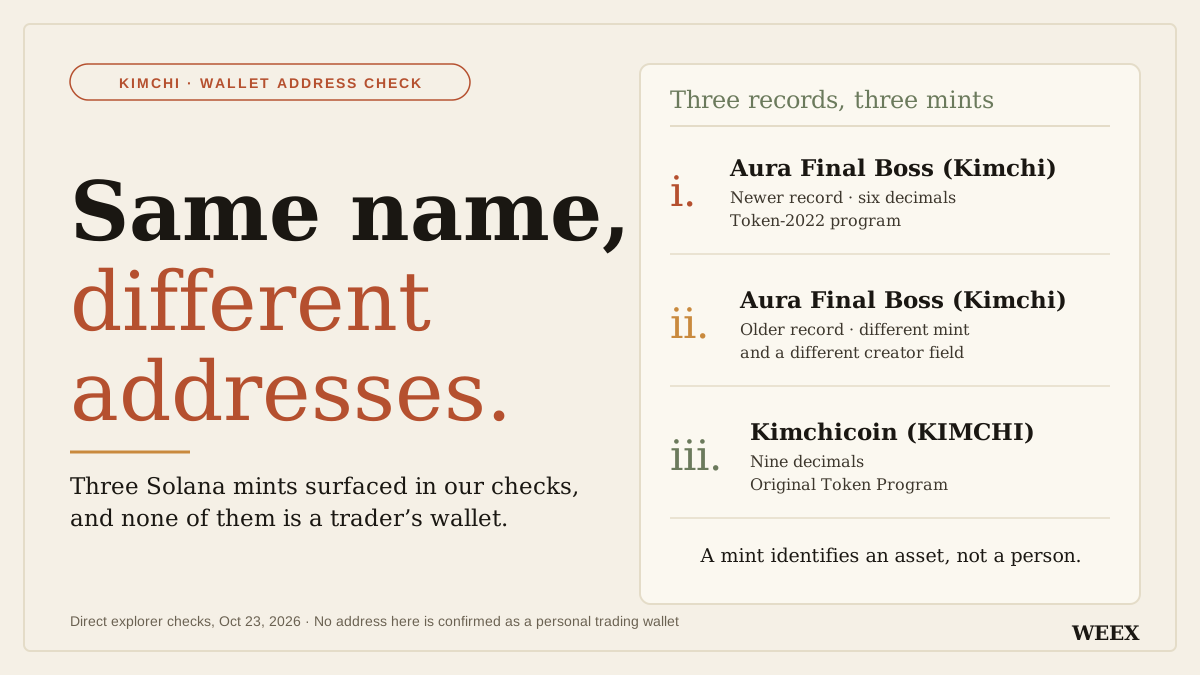
What Is Kimchi Crypto Trader’s Wallet Address? Public Records and Verification Guide
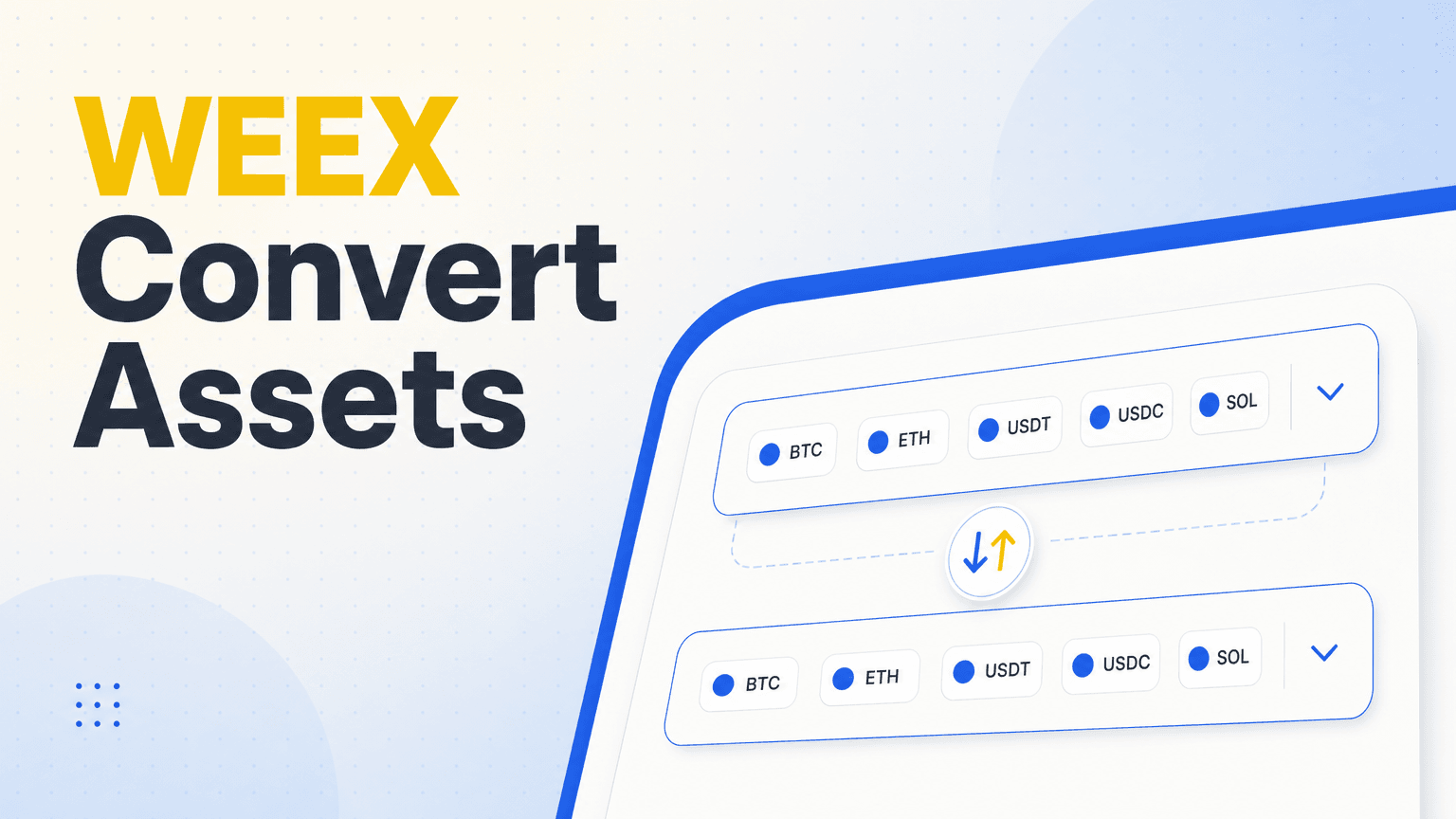
Which Cryptocurrencies Can You Convert on WEEX? How to Check Supported Assets
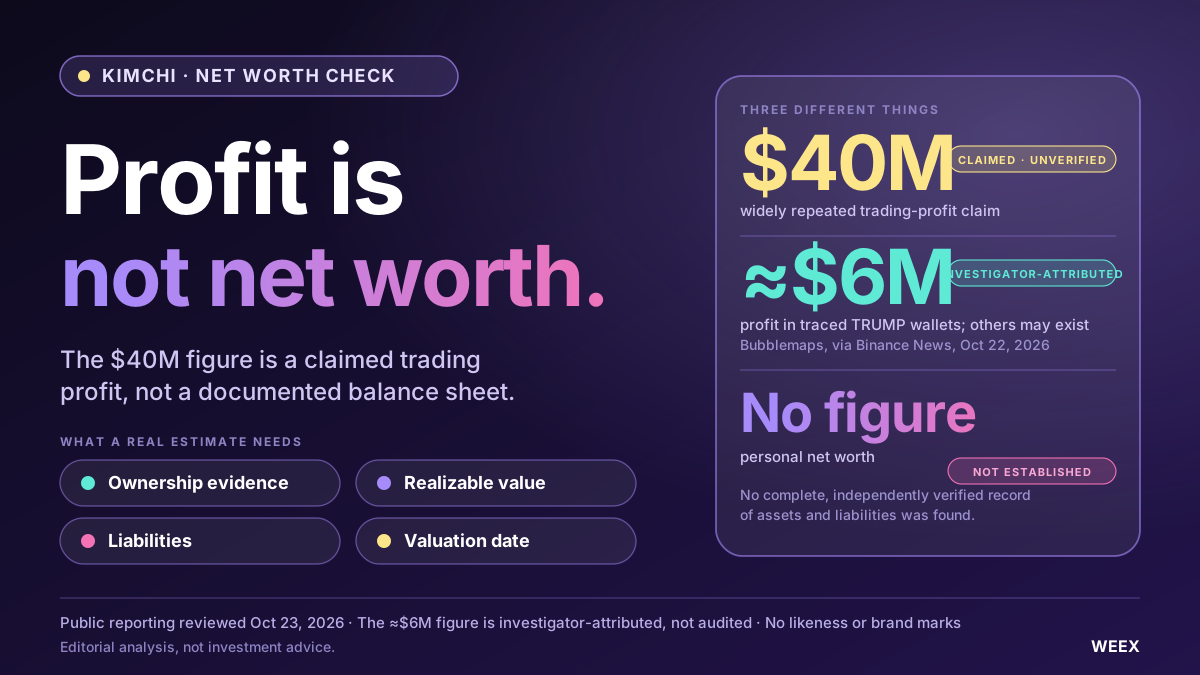
What Is Kimchi Crypto Trader’s Net Worth? Examining the $40 Million Claim

How to Trade Gold in Forex: What XAU/USD Is, How Pips and Lots Work and the Risks to Know
Should Your Crypto Cash Buffer Sit in WEEX Auto Earn? The Math
WEEX Convert Available Balance: How to Check and Use Max
How to Convert ETH to USDT on WEEX: Step-by-Step Guide
How to Convert USDT to BTC on WEEX: Step-by-Step Guide
How to Convert BTC to ETH on WEEX: Step-by-Step Guide
FTR Coin After the Roadster Hype: Why Flying Tesla Roadster Fell Back and What to Check Before Trading

Is Your Crypto Wallet Safe? How to Verify Security Alerts and Spot Phishing
How to Trade Gold in the USA: Futures, ETFs, Bullion and Tokens
Ethereum Funding Rate: How It Works and Why It Dropped Near Zero
Crypto Liquidation Heatmap: Reading the $972M Oct. 15 Long Flush
Margin Trading Crypto: Cross vs Isolated and Liquidation Math
SpaceX Q3 Earnings: 161% Growth, Tesla Merger Talk and SPCX Stock
How to Convert BTC to USDT: A Step-by-Step WEEX Guide
Flexible or Fixed Staking on WEEX? The Odds That Decide It
xStocks Crypto Explained: What Tokenized Stocks Are, How They Work and What Holders Should Check
BTC Funding Rate and Open Interest: What Each One Measures and How to Read Them Together

What Is Pearl (PRL) Crypto and How Does Its Mining Work?

What Happened to Aergo (AERGO) Crypto? Token Migration and What Holders Should Do
What Is Pons Crypto (PONS), and How to Trade PONS on WEEX?
15 Notable Robinhood Chain Protocols: Which Assets Trade on WEEX?
PONS Robinhood Chain Token: What the Buyback Rally Rests On
What Is PONS? Inside the "100x Coin" Taking Over Robinhood Chain
Should I Buy PONS Coin? Sep 2026 Price Prediction & Guide
What Is United States Dividend Fund (USDF)? October Launch Claims and Token Identity Checks


