
What Does the Fed's Hawkish Rate Hike Mean for the Dollar?

 Prefer us on Google


In the absence of new information, the dollar lacks significant downward drivers in the short term.
Written by: Xu Chao, Wall Street Insights
The Fed's unexpectedly hawkish stance has provided the dollar with strong short-term support, but ongoing geopolitical conflicts and political pressures from the upcoming midterm elections keep market uncertainty high, resulting in low confidence in directional judgments in the foreign exchange market.
The Fed's September meeting released strong hawkish signals, and the market's reaction was stronger than previously expected. According to Citigroup research, the results of the September meeting have turned the October meeting into an "active meeting," with the market currently pricing in an additional rate hike of about 13 basis points in October. The dollar index (DXY) has strengthened technically, confirming a double bottom pattern, with a target level pointing to 101.15.
Citigroup research points out that the current macro combination for the dollar—high yields combined with pressured stocks—is historically the most favorable market condition for the dollar. Meanwhile, the euro, Swiss franc, Swedish krona, and New Zealand dollar are all facing downward pressure, with the euro potentially retesting the low of 1.13 against the dollar.
Hawkish Surprises, Rising Expectations for October Rate Hike
Citigroup's previous baseline judgment was that the Fed would struggle to "outpace" the market's hawkish pricing of its policy path, posing a risk of disappointing the market. However, the recent meeting led by Waller completely broke this expectation.
This meeting not only confirmed the rate hike but also the firmness of its forward guidance prompted the market to reassess the subsequent path. The probability of a rate hike in October has significantly increased, with the market pricing in about 13 basis points of additional tightening expectations.
Citigroup believes that although there is a risk of pricing ahead of reality, this tightening expectation may continue to support U.S. Treasury yields and the dollar until the geopolitical conflicts clarify.
Geopolitical Conflicts and Midterm Elections as Ongoing Variables
The geopolitical situation is another core variable in the current foreign exchange market.
According to a Reuters report on September 9, Trump stated that the war with Iran may end after the U.S. midterm elections, which aligns with Citigroup's research team's previous judgment: the November midterm elections could become a trigger point for the situation, and the Iranian leadership may have motives to raise energy prices before the elections.
The spot premium signals in the energy market confirm this judgment. Citigroup states that the spread between spot Brent crude and futures contracts for Brent (the spot premium) has widened significantly again, indicating tight supply in the physical market. As the conflict extends towards the Strait of Hormuz and east-west pipelines, this tense situation is unlikely to ease in the short term. Analysts point out that if the situation shows significant easing, this premium may narrow quickly, but the likelihood of that happening before the midterm elections is relatively low.
Dollar Confirms Double Bottom Technically, but Key Resistance Is Near
From a technical perspective, the DXY's movement provides support for dollar bulls. Citigroup points out that the current price pattern has confirmed a double bottom structure, with a target level pointing to 101.15, similar to the double bottom pattern from April to May—when the DXY overshot to 101.80 after completing the double bottom. If this round of movement replicates the same path, the euro against the dollar will subsequently fall back to the low range of 1.13.
However, the upward space is not without obstacles. Citigroup has marked the range of 102.20 to 102.50 as a key resistance zone, which coincides with the 200-week moving average and historically significant long-term trend lines. Analysts clearly state that this is not a target price but a reminder for investors to pay attention to the potential resistance wall after a possible dollar overextension.
-- Price
Stock Market Pressure Combined with Cooling AI Narrative Provides Additional Support for the Dollar
The performance of the equity market provides additional support for the dollar.
Citigroup points out that it is historically common for the stock market to experience volatility at the beginning of a rate hike cycle, and the U.S. stock market has begun to show signs of this. Looking longer term, social and political resistance surrounding artificial intelligence, as well as uncertainties in model development, may continue to suppress market sentiment before the midterm elections.
Citigroup's U.S. equity strategy team maintains an upward judgment driven by earnings before the end of the year but acknowledges that during the window period before the earnings season, the triple pressure of negative AI narratives, high interest rates, and geopolitical risks may keep the market in a state of high volatility.
Citigroup emphasizes that the combination of rising yields and falling stocks is historically the most favorable macro state for the dollar, and the current market is in this state, with further follow-up space likely in the coming days.
Beware of Rapid Reversal of the Situation
Although the logic for a bullish dollar in the short term is clear, Citigroup's research team repeatedly emphasizes that there is a risk of reversal in the overall judgment. First, the market has already priced in a lot for this FOMC, and the marginal bullish effect is diminishing; second, the adjustment of the PCE statistical method remains a potential variable to be digested; third, the price movements on the Fed's decision day have historically been volatile, making it unwise to overinterpret the movements of that day.
Citigroup concludes that in the absence of new information, the dollar lacks significant downward drivers in the short term, and the path for the euro against the dollar to retest the low of 1.13 remains open. However, under the current market conditions, the situation can fundamentally change in a very short time, and investors should avoid overcommitting to a single direction.
This content is provided for general informational purposes only and doesn't constitute financial, investment, legal, or tax advice. Any events, rewards, online promotions, or related information mentioned herein should not be considered a recommendation, solicitation, or invitation to purchase, sell, trade, or otherwise deal in any crypto assets. Crypto assets are highly volatile and may result in loss. The availability of WEEX services, products, and related events may vary by region. You are responsible for ensuring that your participation is in accordance with applicable local laws and regulations.
You may also like

Follow the Money: $630 Million for Strive, Tether Activity and Attention to CeFi

HTX Research Analyst Chloe: Despite Significant Net Inflows into Bitcoin Spot ETFs, Macroeconomic Data Suppresses Rebound Potential

Killa: Frequent Short-term Trading Risks Missing Major Market Movements, Patience in Holding Positions is Important

China's fiscal revenue rose 5.1% by September, but land sales continue to decline

90% of Revenue from Meme Coins, Yet Valuation Rivals Pump: What Should Meteora Be Worth?

Former FTX Executive Slams Netflix's New Series: Turning Financial Fraud into a 'Romantic Film' is Absurd

Ripple teams up with $10B payments firm Arf to expand RLUSD use on XRPL

One billion dollars in three days is not enough. Bitcoin faces a significant challenge

WEEX Exclusive:Major Indexes Close Higher; Focus on TSLA, META Stock Earnings | WEEX TradFi Daily(October 22, 2026)

Major Indexes Close Higher; Focus on TSLA, META Stock Earnings | WEEX TradFi Daily(October 22, 2026)
The three major indexes closed higher on October 21, led by the Nasdaq. SpaceX beat earnings expectations and disclosed AI-business revenue; merger discussions with Tesla also helped lift AI and crypto-related stocks. Bitcoin traded near $84,000 and Ethereum near $2,470. LIT led majors on compliance-license expectations. On October 22, investors will watch Procter & Gamble, Southern Copper and Union Pacific before the open, followed by Western Digital and Newmont after the close.

Irish drug lord’s lost Bitcoin fortune comes back to life as $41 million moves to Coinbase

ZachXBT Reports on Cryptocurrency Laundering via FreedomXMR on Hyperliquid

Willy Woo: Good Time to Accumulate Bitcoin

Tech and AI: Hedge Funds Reduce Exposure at Unprecedented Rate in Ten Years

The Qubic network is back in operation after the hacking of users

Crypto rallies point to slower USDC growth and faster USDT growth, study finds
North Korea-linked SquidSquad suspected in $2.84M BNB Chain theft

Putting Childhood on the Trading Table: TCG May Be the Closest Moment for Young People to Get Rich

Kraken’s $80 stablecoin fee gap exposes hidden costs

Justin Sun Sells 80-90% of His ETH: Bitcoin Warning
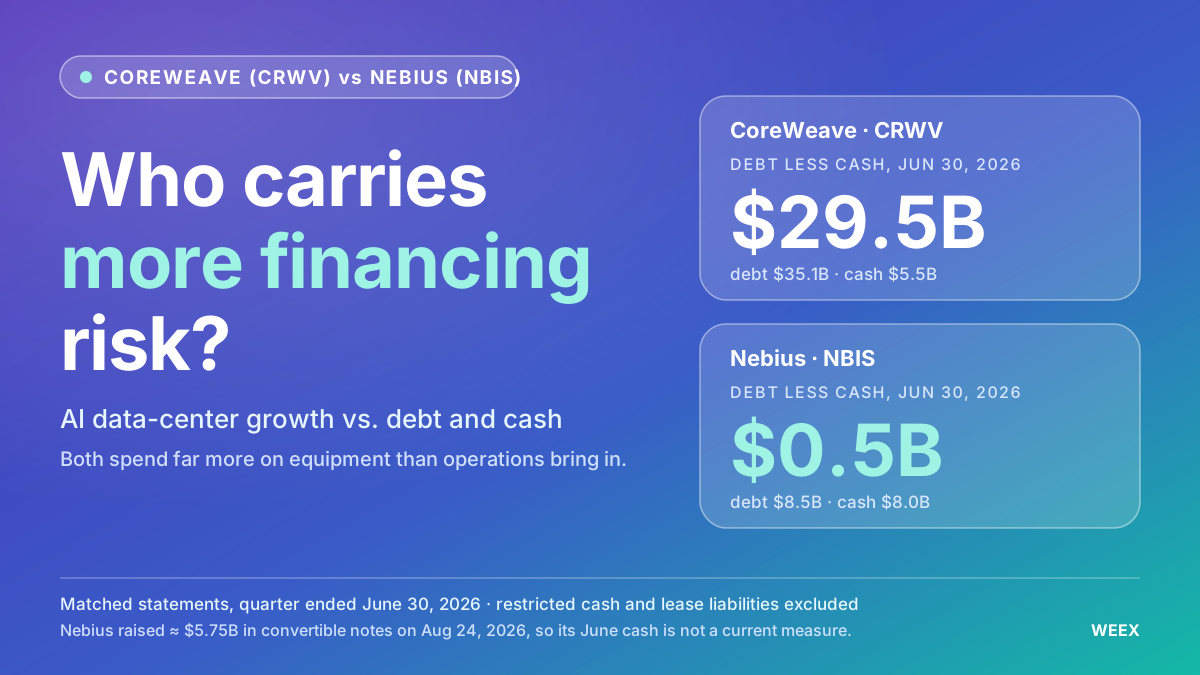
CoreWeave vs. Nebius Stock: Which AI Cloud Business Faces Greater Financing Risk?
Compare CoreWeave and Nebius stock through debt, cash flow, customer prepayments and dilution to assess which AI cloud business faces greater financing risk.

Cryptocurrency Exchange Bitget Suddenly Exits Russia. What Happened
EU bans cash payments over €10,000 starting July next year
Country risk near 680 points: why Argentine bonds fall despite international relief

Bitcoin at $100,000 in 2026: Bitwise Remains Optimistic Despite Inflation

Bitcoin Wallet Moves 411.45 BTC Worth 33400000 Dollars Amid Lawsuit

Bank of America predicts a hit of up to 10% on European stocks due to risks in the AI cycle

Fake Demand, Real Losses: How Popular Crypto Schemes Work

BNB Chain claims 42.6% of tokenized stock market, beating Ethereum and Solana
Freezing and Confiscation of Cryptos: Europe Strengthens Cooperation Against Criminal Networks
Follow the Money: $630 Million for Strive, Tether Activity and Attention to CeFi
HTX Research Analyst Chloe: Despite Significant Net Inflows into Bitcoin Spot ETFs, Macroeconomic Data Suppresses Rebound Potential
Killa: Frequent Short-term Trading Risks Missing Major Market Movements, Patience in Holding Positions is Important
China's fiscal revenue rose 5.1% by September, but land sales continue to decline
90% of Revenue from Meme Coins, Yet Valuation Rivals Pump: What Should Meteora Be Worth?
Former FTX Executive Slams Netflix's New Series: Turning Financial Fraud into a 'Romantic Film' is Absurd
Contents
Latest articles


Latest coin listings on WEEX


