
How Syncro Sender Optimizes Solana Transactions for High-Stakes Teams

 Prefer us on Google

Key Takeaways:
- Syncro Sender uses multi-path delivery and staked validator connections to enhance Solana transaction efficiency.
- It significantly reduces landing latency compared to public RPC endpoints by leveraging Stake-Weighted Quality of Service (SWQoS).
- The service reports a 99.2% transaction inclusion rate with a 99% slot 0 to 1 landing rate.
- Globally positioned infrastructure supports continuous and swift execution across six regions.
- Designed for seamless integration, Syncro Sender requires no changes in existing transaction logic.
WEEX Crypto News, 2026-04-22 12:12:12
Boosting Solana Transaction Efficiency
Syncro Sender, developed by P2P.org, is engineered to cut transaction latency and enhance efficiency for Solana, a network processing over 162 million transactions daily. While typical users find the speed sufficient, trading firms and arbitrage bots require every millisecond. The crucial delay isn’t in Solana but in how transactions reach the network’s leaders.
Networking Bottlenecks and Syncro Sender’s Solution
Public RPC endpoints, though accessible, are not tailored for time-sensitive operations. They split bandwidth among numerous users without guaranteeing speed or priority. Syncro Sender offers a refined path by utilizing Stake-Weighted Quality of Service, where priority bandwidth through staked validator connections accelerates transaction processing, outperforming methods relying on merely priority fees or Jito tips. This approach minimizes competition for bandwidth and assures quicker execution.
Unique Architectural Features
Syncro Sender differentiates itself through several innovative strategies. By employing validator-level routing and using SWQoS connections, transactions gain priority access to bandwidth reserved for staked validators. In peak times, this setup proves vital for maintaining performance, especially in trading workflows. Moreover, its multi-path delivery means transactions simultaneously target multiple routes to reach the current and upcoming block leaders. This redundancy ensures optimal chances of a swift landing, with independent benchmarks indicating substantial reductions in transaction lag.
-- Price
Global Infrastructure Advantage
Deployments in key locations—Amsterdam, Frankfurt, New York, London, Tokyo, and Singapore—ensure minimal latency irrespective of where the active validator cluster is located. This global setup prevents unnecessary data hops, shaving off valuable milliseconds in transaction times. For Solana’s ever-rotating leader schedule, such geographic coverage is essential.
Seamless Integration for Enhanced Performance
Syncro Sender integrates effortlessly with existing systems, requiring no overhaul of transaction flow or signing logic. Teams only need to add a tip instruction to the transactions. The system allows concurrent operation with current setups, enabling comparative analysis and real-world performance evaluations. The solution has shown stellar results, boasting a 99.2% inclusion rate and confirming most transactions in slot 0 or 1 with an average latency of 1.2 slots.
Built on Robust P2P.org Infrastructure
The service is backed by P2P.org’s robust staking infrastructure. With $10 billion in assets and operations across 40 blockchain networks, P2P.org provides reliable validator services, ensuring that staked connections support Syncro Sender’s superior performance. This secure foundation promises both SWQoS priority routing and comprehensive global endpoint coverage.
Getting Started with Syncro Sender
For testing, Syncro Sender offers a public endpoint without an API key. It supports up to one request per second at a cost of 0.0001 SOL per transaction. For higher demands, a private endpoint allows up to 50 requests per second with full RPC method support. Detailed documentation is provided for integration, helping teams make informed choices based on their specific execution needs.
FAQ
How does Syncro Sender improve Solana transaction speeds?
Syncro Sender boosts Solana transaction speeds by routing transactions through staked validator connections and deploying across multiple paths to ensure faster delivery to network leaders.
What differentiates Syncro Sender from standard RPC endpoints?
Unlike standard RPC endpoints, Syncro Sender uses Stake-Weighted Quality of Service and validator-level routing to prioritize and expedite transactions significantly.
How does multi-path delivery benefit transaction processing?
Multi-path delivery targets transactions through various routes to reach leaders first, enhancing the likelihood of faster transaction execution and reducing latency.
Is Syncro Sender available globally, and why is this important?
Yes, with infrastructure in key global locations, Syncro Sender minimizes latency by reducing data hops and ensuring consistent performance across different Solana leader slots.
What integration steps are necessary for existing setups?
Current systems can easily integrate Syncro Sender by adding a simple tip instruction to their transactions, allowing seamless operation alongside existing solutions.
This content is provided for general informational purposes only and doesn't constitute financial, investment, legal, or tax advice. Any events, rewards, online promotions, or related information mentioned herein should not be considered a recommendation, solicitation, or invitation to purchase, sell, trade, or otherwise deal in any crypto assets. Crypto assets are highly volatile and may result in loss. The availability of WEEX services, products, and related events may vary by region. You are responsible for ensuring that your participation is in accordance with applicable local laws and regulations.
You may also like

Solana Reduces Transaction Finalization Time to About 1/85 with 'Alpenglow' Now Live on Mainnet

Marinade Q3 Report: SOL Staking Volume Grows 21.2% to 7.94 Million, Revenue Approximately $1 Million

HTX Research predicts increased crypto market volatility in next 2 weeks
JPMorgan Asset Management Offers Tokenized MMFs on Solana

Solana pitches Quantumglow to protect Alpenglow from quantum attacks

Sam Price Analyzes Bitcoin Price Fluctuations

eUSD (Telcoin): price $1.00, market capitalization $10.04M

Dune Launches Real-Time Market Data Stream Covering 12 Blockchains and 200 Trading Platforms

Solana targets faster finality, while Wall Street cuts the cash that must move

Beyond Prediction Markets: How to Determine Whether Bitcoin Will Rise or Fall?
Grayscale Allows Cryptocurrency Exchange for ETF Shares
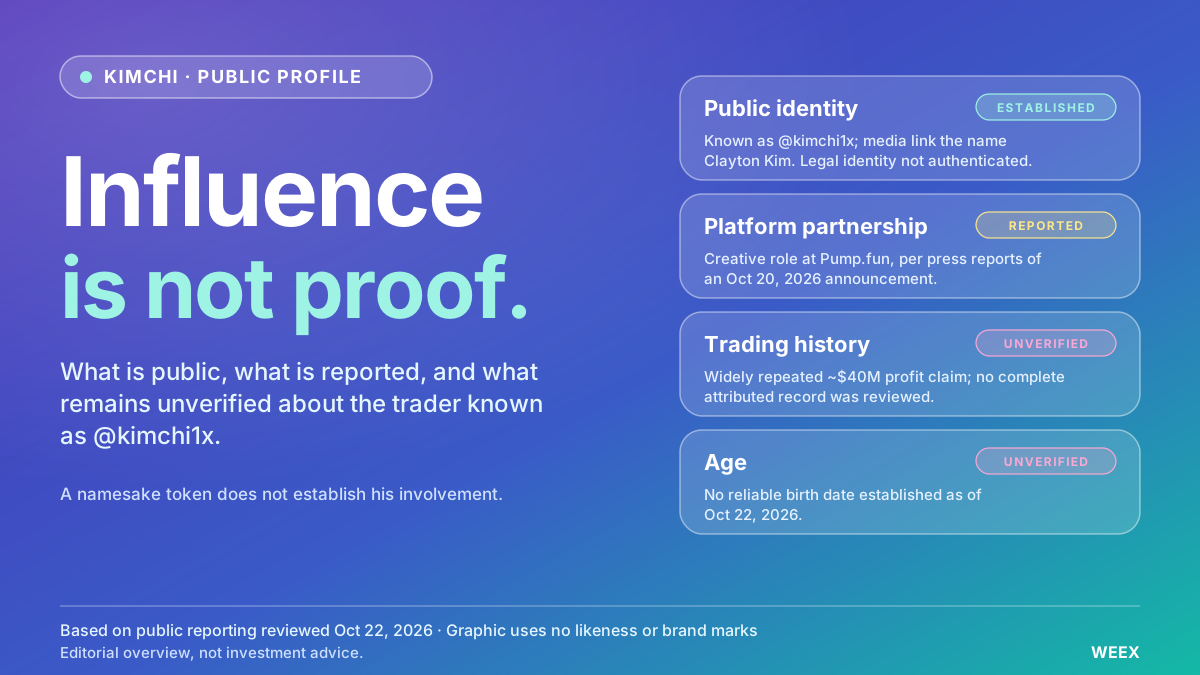
Who Is Kimchi Crypto Trader? Age, Real Name, and Trading Background
Who is Kimchi crypto trader? Check what is known about his age, the name Clayton Kim, trading background, profit claims, and Pump.fun partnership.

Collector Crypt Achieves Record Daily Trading Volume of $24.3 Million in 24 Hours

GMX Introduces 180-Day Unstaking Waiting Period for Staking, Solana Revenue Used for Buybacks
Stablecoin shopping draws gacha pitch as SP3ND plans randomized purchases
Ethereum Staking Reaches 43.8 Million ETH, Robinhood Chain's First Quarter Trading Fees Exceed $50 Million

SkyAI Major Shareholder Demands Explanation for Liquidation of SOL Holdings and Increase in Buyback Offer
GTA 6's fictional token Dacity Coin sparks speculation for Solana's similarly named token

Western Union Launches USDPT Stablecoin Remittance Service

Goldman Sachs is the largest holder of ETFs on Solana

Solana Launches Largest Upgrade Alpenglow Since 2020
Solana Surpasses Robinhood Chain with 1.5 Million Tokenized Shareholders
Solana transaction failure rate drops to 30.6%

Hylo Completes $1 Million Strategic Financing Led by Solana Ventures

Solana’s Yakovenko questions Alpenglow build as vote transactions exit
Kamino Increases CCIP Cross-Chain Asset Lending Limits and LTV
NEAR Launches Confidential Multi-Signature Vault Platform NEAR Business Supporting 35 Chains

Ethereum staking reaches record 43.8 million ETH in Q3

Solana Becomes the Most Profitable Blockchain Network, SOL Price Drops 15%
Matera and Others Demonstrate US QR Code Payment Standard X9.150 at Money20/20
Solana Reduces Transaction Finalization Time to About 1/85 with 'Alpenglow' Now Live on Mainnet
Marinade Q3 Report: SOL Staking Volume Grows 21.2% to 7.94 Million, Revenue Approximately $1 Million
HTX Research predicts increased crypto market volatility in next 2 weeks
JPMorgan Asset Management Offers Tokenized MMFs on Solana
Solana pitches Quantumglow to protect Alpenglow from quantum attacks
Sam Price Analyzes Bitcoin Price Fluctuations


