
Government and ruling party postpone decision on cryptocurrency tax exemption amid equity and infrastructure concerns

 Prefer us on Google


[Block Media Reporter Oh Soo-hwan] The Democratic Party of Korea and the government held discussions regarding the taxation of digital assets (cryptocurrencies) set to take effect in January next year but did not reach a conclusion on whether to postpone the tax. While there was consensus on the principles of taxation, there are several issues that need to be resolved, including equity in taxation with overseas exchanges, tax system adjustments reflecting the changed market environment, and the establishment of IT infrastructure. The ruling party and government decided to further review the related matters before finalizing their stance.
Kim Min-seok, the leader of the Democratic Party of Korea (fourth from the right), and Deputy Prime Minister and Minister of Economy and Finance Lee Hyung-il (fifth from the right), along with other attendees, held a 'Digital Asset Taxation Consultation Meeting' at the National Assembly on the 28th. Photo = Block Media
On the 28th, the Democratic Party and the government convened a consultation meeting at the National Assembly to discuss the possibility of an additional postponement of digital asset taxation but failed to reach a conclusion. At the Democratic Party's general meeting the day before, many voices expressed the need for a postponement, but opinions were sharply divided within the National Assembly's Finance and Economy Committee, which is responsible for the matter.
Chairman of the Finance and Economy Committee Cho Seung-rae stated, "Opinions among the committee members are quite divided." While there seems to be support for postponement within the party, there are also strong voices opposing repeated delays in implementation, resulting in no final decision being made.
Oh Gi-hyung, the ruling party's secretary of the Finance and Economy Committee, also mentioned, "In principle, since we have already postponed it three times, there are opinions that we should proceed with taxation as scheduled and opinions that we should address several shortcomings," adding, "We will conduct additional reviews at the party level."
Democratic Party lawmaker Yoon Hoo-deok clearly opposed any further postponement during the National Assembly's audit of the Finance and Economy Committee on the 22nd. He stated, "A few years ago, we pointed out the same issue and said we would prepare during the postponement period, but we are repeating the same words," expressing concern that postponing or abolishing laws passed by the National Assembly with bipartisan agreement for different reasons undermines the legal foundation of South Korea and damages policy credibility.
Digital asset taxation was introduced through amendments to the Income Tax Act in 2020 and was originally scheduled to be implemented in 2022, but it has already been postponed three times.
Those advocating for postponement argue that the issue of equity among users of domestic and foreign exchanges must be resolved before the implementation of taxation. Domestic exchanges can easily verify users' transaction histories and acquisition costs, while transactions through foreign exchanges or personal wallets make it difficult to secure relevant data. As a result, there are concerns that the tax status may vary depending on the transaction route, even for the same investment returns.
The urgent task is also to establish tax standards for diversified transaction types, such as overseas perpetual futures trading. If taxes are imposed on domestic spot trading while failing to accurately assess income from overseas derivative trading, it will inevitably lead to distortions in equity among investors.
The fact that the Digital Asset Basic Law has not yet been enacted is also cited as a major basis for the postponement argument. The government and the National Assembly are pushing for the enactment of a basic law that encompasses the issuance, distribution, and regulation of digital assets, but the institutional framework has not been completed. The ongoing debate over whether it is appropriate to tax only individual investors' profits while corporate market participation and domestic digital asset issuance are blocked is a reason for the controversy.
The industry also holds the position that establishing clear tax standards and building a system for securing transaction information should take precedence before enforcing taxation. The Digital Asset Exchange Joint Council (DAXA) gathered opinions from 27 domestic virtual asset businesses in September, highlighting major challenges such as proving acquisition costs of assets inflowing from abroad, withholding tax for non-residents, and establishing a system for exchanging transaction information across countries.
Moreover, there are ongoing criticisms regarding the ambiguity of tax standards for income generated from various transaction methods such as staking, airdrops, and decentralized finance (DeFi). There are also strong demands for institutional improvements to realize tax burdens for investors, such as the introduction of loss carryforward deductions and raising the basic deduction limit.
Meanwhile, the timing of the government's announcement of tax-related guidelines has also become a point of contention. Chairman Cho Seung-rae suggested that the government should postpone the announcement of the guidelines until a decision on taxation is made, as the preparation of the guidelines by the end of this month could be interpreted as a signal that taxation will proceed as scheduled.
Exchanges argue that even if tax standards are finalized, they will need physical time to reflect this in their IT systems and verify it. During a field meeting hosted by the government on the 20th, the industry requested sufficient preparation time to establish a system for submitting tax data.
A representative from a domestic exchange stated, "Even if the detailed tax standards and guidelines are finalized, there is insufficient time to reflect this in the system and check for errors to ensure stability," adding, "We need a sufficient grace period for building an IT network and conducting multiple verification tasks to accurately submit investors' transaction histories and acquisition cost data to the National Tax Service."
The Democratic Party plans to continue discussions with the government after further gathering opinions within the party. The government also plans to comprehensively review the tax preparation status and industry opinions. The final decision on whether to postpone and for how long is expected to become clearer during the National Assembly's tax law review process in November.
-- Price
This content is provided for general informational purposes only and doesn't constitute financial, investment, legal, or tax advice. Any events, rewards, online promotions, or related information mentioned herein should not be considered a recommendation, solicitation, or invitation to purchase, sell, trade, or otherwise deal in any crypto assets. Crypto assets are highly volatile and may result in loss. The availability of WEEX services, products, and related events may vary by region. You are responsible for ensuring that your participation is in accordance with applicable local laws and regulations.
You may also like

$LIBRA Case: Justice Delays Key Decision That Could Determine the Closure of the Investigation

Solana Alpenglow Goes Live, Targeting 150-Millisecond Finality

Why Third Parties Again? A Review of Coinbase's Supply Chain Risks and Defense Dilemmas

House Oversight Chair Comer Probes Delaware Plan for AI-Run Companies

Birch Hill Completes $4 Million Seed Round Financing Led by Multicoin Capital

Thailand's Supreme Court Rules Bitcoin as Property in Legal Terms

Crypto: USDC Overtakes USDT in the European Market

Morgan Stanley Research on China's Robot Market: Companies Still Want Humanoid Robots, but Large-Scale Deployment Will Have to Wait

Nomura: AI Trading Reversal May Affect Dollar's Safe-Haven Status
Looking Ahead to Tonight's Federal Reserve Meeting: A Pause in Rate Hikes in October is Almost Certain, How It Affects December Rate Hike Probabilities Becomes the Focus

Controversial AI Data Centers in France: The Map of 'Computing Factories', and Bitcoin Still on the Sidelines

Keystone to Destroy 18,835 Crypto Wallets After Hack

Revolut Under Scrutiny: London Examines Its Product Launches

LDP lawmakers discuss crypto property rights in Japan

TBC Welcomes AI Machine Business Entry After Nine Payments

Standard Chartered Launches RLUSD Custody, Plans Collateral Model

South Korea ruling party considers delay to crypto tax implementation

SEC Requires 30 Days’ Notice for Tokenised US Stock Venues

$40.41 Million Remains Withdrawable on Blast Bridge
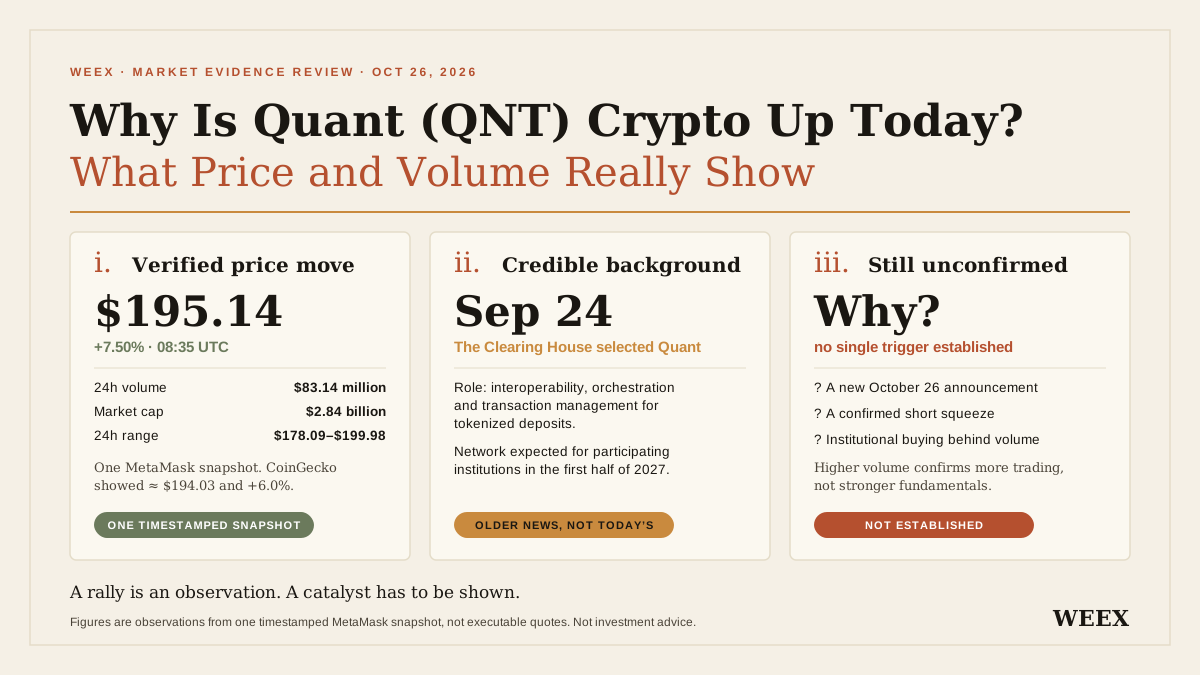
Why Is Quant (QNT) Crypto Up Today? What Price and Volume Really Show
Why is Quant (QNT) up today? Review price and volume evidence, the banking partnership timeline, token-demand assumptions, and risks before trading.
ECB says digital euro will give Europe control over its payment systems

Ethereum Releases CALLSTATUS Instruction EIP Draft

Dragonfly Partner Responds to DFINITY's Technology Infringement Allegations, Related Patent Approved at the End of July

Firedancer makes bounty hunters burn 1 SOL even for duplicate bug reports

CoinShares BTF Liquidation Confirms Cash Payout And November 20 Options Expiry

SpaceX perpetual futures traded about $6 billion after earnings

Zcash on an Upward Trend, Targeting $2000

How to Reconstruct an Enterprise-Level AI Data Platform When Data Moves Towards Understanding?

Evan Conrad: Most AI Startups Will Be Unable to Purchase Computing Power in the Next 6 Months

SSV Labs Proposes Extension of Network Hosting Services to Mid-2027
$LIBRA Case: Justice Delays Key Decision That Could Determine the Closure of the Investigation
Solana Alpenglow Goes Live, Targeting 150-Millisecond Finality
Why Third Parties Again? A Review of Coinbase's Supply Chain Risks and Defense Dilemmas
House Oversight Chair Comer Probes Delaware Plan for AI-Run Companies
Birch Hill Completes $4 Million Seed Round Financing Led by Multicoin Capital
Thailand's Supreme Court Rules Bitcoin as Property in Legal Terms


