
300 Publishers Call on Congress to Regulate AI Bot Scraping

 Prefer us on Google



Condé Nast and Hearst are among the 300 publishers who, in a lobbying campaign reported on September 30, 2026, are asking Congress for regulation of undisclosed AI bot scraping.
The focus is on unidentified bots that collect content from websites without disclosing themselves. Publishers support a bipartisan bill that would require these bots to declare their identity and purposes, under penalty of civil sanctions.
Key Points
- Three hundred publishers are calling for mandatory transparency for bots that copy content from the web.
- The Stealth Bot Prohibition Act includes federal penalties and the involvement of state attorneys general.
- Some publishers in the campaign also have paid agreements for licensing content to AI.
Publishers Seek Congressional Rules on AI Bot Scraping
Publishers want federal standards against undisclosed scraping to impose transparency on bots that collect content. The request comes as AI impacts website traffic, search, and online visibility.
According to Mashable, executives linked to Esquire, Cosmopolitan, Vogue, and Vanity Fair have lobbied in Washington for the Stealth Bot Prohibition Act. The News/Media Alliance supports the legislation and states that disguised bots harm publishers' ability to serve readers and protect their content.
At the presentation of the text, the alliance's president Danielle Coffey stated that technical defenses are insufficient against bots that hide their identity.
"We are overwhelmed by bot traffic, which harms our ability to serve readers, and existing technical tools are not enough to protect our content from malicious actors who can disguise their identity," Coffey said.
Debi Chirichella, president of Hearst Magazines, called the law a step towards a clean internet. Roger Lynch, CEO of Condé Nast, accused AI companies of using disguised bots to take original journalism without accountability.
What the Stealth Bot Prohibition Act Entails
The bill would require scraping bots to disclose their identity and purposes to website publishers. Those who fail to do so would face civil penalties enforced by the Federal Trade Commission.
The bipartisan proposal was introduced in the House in July. It targets stealth bots, which are unidentified AI agents used to collect and index website content without disclosure.
The text would also authorize state attorneys general to act against AI scraping. In summary, the regulation revolves around transparency, with federal civil penalties and actions from state attorneys general.
-- Price
AI Licenses Coexist with the Transparency Battle
Among the publishers seeking more protections, some have already signed agreements to profit from the use of their content in AI training and research. The agreements involve OpenAI, Google, Microsoft, Meta, and Amazon.
- OpenAI: In 2024, Condé Nast initiated a multi-year collaboration; licensing agreements have also been signed by Associated Press, The Atlantic, and TIME, as well as The Guardian and Axios. The Washington Post has agreed to include its original journalism within ChatGPT.
- Google: In January 2025, it closed its first AI licensing agreement with Associated Press.
- Microsoft: It has formed agreements with Associated Press, People Inc., and USA Today Co.
- Meta: It has signed a multi-year licensing and training agreement covering seven publishers, including CNN and Fox News.
- Amazon: Among the publishers it has reached agreements with are The New York Times, Condé Nast, and Hearst.
On the legal front, in April 2025, Ziff Davis, the parent company of the publisher of this service, sued OpenAI for copyright infringement in the training and operation of its AI systems.
Content created with the assistance of artificial intelligence and human editorial review.
This content is provided for general informational purposes only and doesn't constitute financial, investment, legal, or tax advice. Any events, rewards, online promotions, or related information mentioned herein should not be considered a recommendation, solicitation, or invitation to purchase, sell, trade, or otherwise deal in any crypto assets. Crypto assets are highly volatile and may result in loss. The availability of WEEX services, products, and related events may vary by region. You are responsible for ensuring that your participation is in accordance with applicable local laws and regulations.
You may also like

Ethereum staking yield is losing to cash rates, so why are investors still lining up?

New OCC stablecoin rule resets redemptions, and banks face big shifts

What Is an Agentic Activities Launchpad? Inside AX1 Console 2.0

The GENIUS Act Leaves Loopholes, Banks Warn of Potential $850 Billion Loan Shrinkage

Franklin Templeton wins Nasdaq approval for 2 dividend-to-BTC ETFs

QCP Capital: Credit Pressure in AI Infrastructure Drags Down Crypto Market

How to Reconstruct an Enterprise-Level AI Data Platform When Data Moves Towards Understanding?

NEAR proposal slashes yield by 36%, dividing network validators

Senator Blumenthal investigates Tether payments to Bo Hines-linked firm

No Tax on Bitcoin Gains if Not Sold, Even with 30% Increase: How Will the U.S. Tax It?

SideSwap reopens Bitcoin swaps, 600 peg-outs processed since October 20

Canada P2P crypto activity falls from 650,000 peak as student numbers drop

New memecoin KIMCHI reaches valuation of 40 million dollars

Zebec Network reports $100,000 buyback of 40.5M ZBCN in Q3

CFTC: Cash Bitcoin Purchases May Fall Under Futures Rules

Tech and AI: Hedge Funds Reduce Exposure at Unprecedented Rate in Ten Years

Beyond HODLing: How Bitcoin-Backed Loans Can Unlock New Financial Opportunities

唐华斑竹 Analyzes QQQI Investment Strategy and Returns

Mastercard Launches Early Access to Payment System for AI Agents
Arkham Launches Paywall, ARKM Token Rises 8%
Park Soo-young: The Democratic Party Needs to Establish a Position on Digital Asset Taxation Delay

Circular Founder Claims Axiom Bribery Only 1% Traceable to On-Chain Incentives

Bitcoin's next selloff could be amplified by the traders still betting on its recovery

Tether joins Tenstorrent’s $1.5B round as AI investments grow

Strive Surpasses Saylor in Bitcoin Purchases: What Is This Company?
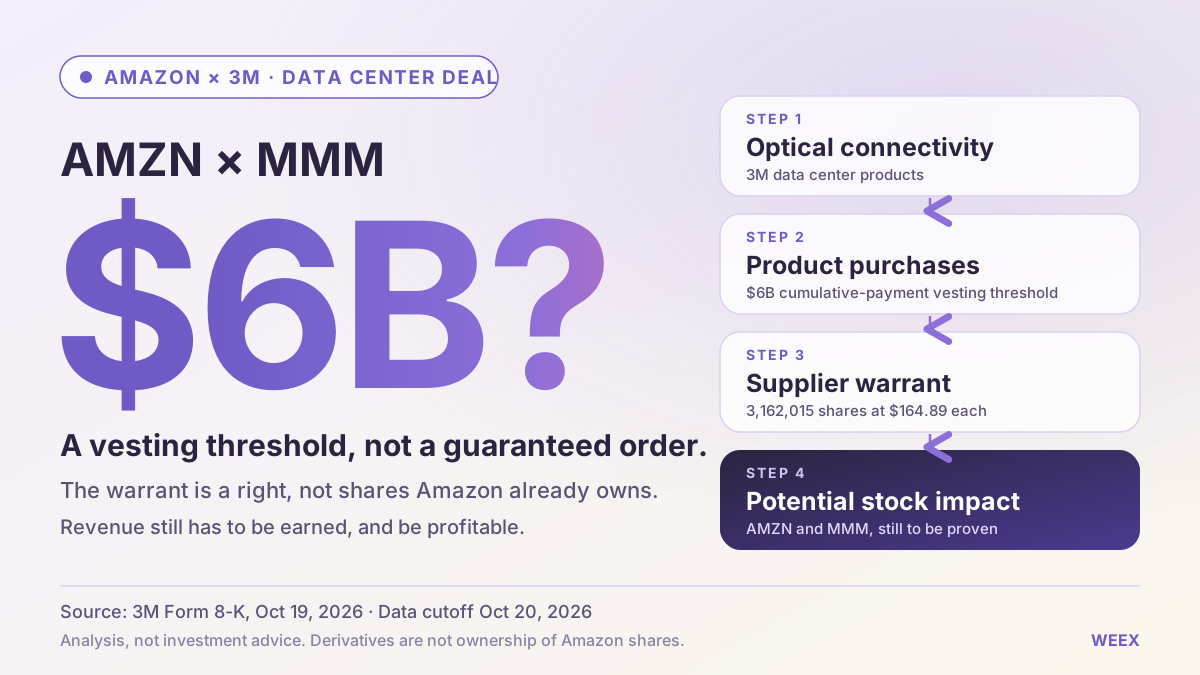
Amazon’s 3M Data Center Deal: What It Means for Amazon (AMZN) and 3M (MMM) Stock
Assess Amazon’s 3M data center deal, the $6 billion warrant threshold, potential dilution, and what the agreement could mean for AMZN and MMM stock.
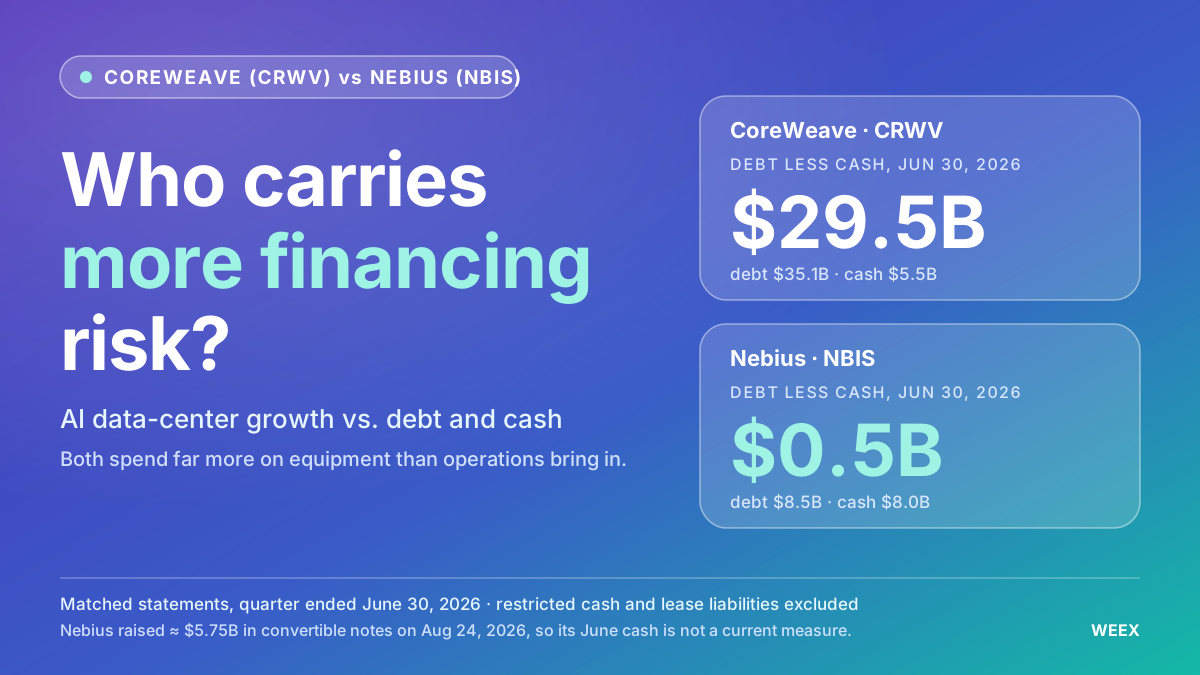
CoreWeave vs. Nebius Stock: Which AI Cloud Business Faces Greater Financing Risk?
Compare CoreWeave and Nebius stock through debt, cash flow, customer prepayments and dilution to assess which AI cloud business faces greater financing risk.

Mr&强 Analyzes BTC and ETH Short-Term Strategies
Matera and Others Demonstrate US QR Code Payment Standard X9.150 at Money20/20

Aqar Exit Raises $200,000 from Ayman Abbas at a $2 Million Valuation
Ethereum staking yield is losing to cash rates, so why are investors still lining up?
New OCC stablecoin rule resets redemptions, and banks face big shifts
What Is an Agentic Activities Launchpad? Inside AX1 Console 2.0
The GENIUS Act Leaves Loopholes, Banks Warn of Potential $850 Billion Loan Shrinkage
Franklin Templeton wins Nasdaq approval for 2 dividend-to-BTC ETFs
QCP Capital: Credit Pressure in AI Infrastructure Drags Down Crypto Market





